Books Like “Who's Afraid of Virginia Woolf?

If you enjoyed Who's Afraid of Virginia Woolf? by Edward Albee, you might also like these similar reads.

Cover of The second Mrs. Tanqueray

The second Mrs. Tanqueray

Arthur Wing Pinero

1894

Aubrey Tanqueray's Chambers in the Albany-a richly and tastefully decorated room, elegantly and luxuriously furnished: on the right a large pair of doors opening into another room, on the left at the further end of the room a small door leading to a bedchamber. A circular table is laid for a dinner for four persons which has now reached the stage of dessert and coffee. Everything in the apartment suggests wealth and refinement. The fire is burning brightly. Aubrey Tanqueray, Misquith, and Jayne are seated at the dinner-table. Aubrey is forty-two, handsome, winning in manner, his speech and bearing retaining some of the qualities of young-manhood. Misquith is about forty-seven, genial and portly. Jayne is a year or two Misquith's senior; soft-speaking and precise-in appearance a type of the prosperous town physician. Morse, Aubrey's servant, places a little cabinet of cigars and the spirit-lamp on the table beside Aubrey, and goes out.

Cover of Nathaniel Hawthorne and his wife

Nathaniel Hawthorne and his wife

Julian Hawthorne

1884

Explore the life and work of one of America's most beloved writers, Nathaniel Hawthorne. From his humble beginnings to his rise to national acclaim, readers will gain a new appreciation for the man behind such iconic works as The Scarlet Letter and The House of the Seven Gables. This work has been selected by scholars as being culturally important, and is part of the knowledge base of civilization as we know it. This work is in the "public domain in the United States of America, and possibly other nations. Within the United States, you may freely copy and distribute this work, as no entity (individual or corporate) has a copyright on the body of the work. Scholars believe, and we concur, that this work is important enough to be preserved, reproduced, and made generally available to the public. We appreciate your support of the preservation process, and thank you for being an important part of keeping this knowledge alive and relevant.

Cover of Gone Girl

Gone Girl

Gillian Flynn

2011

THE ADDICTIVE No.1 BESTSELLER THAT EVERYONE IS TALKING ABOUT Who are you? What have we done to each other? These are the questions Nick Dunne finds himself asking on the morning of his fifth wedding anniversary, when his wife Amy suddenly disappears. The police suspect Nick. Amy's friends reveal that she was afraid of him, that she kept secrets from him. He swears it isn't true. A police examination of his computer shows strange searches. He says they weren't made by him. And then there are the persistent calls on his mobile phone. So what really did happen to Nick's beautiful wife?

Cover of The Valley of the Moon

The Valley of the Moon

Jack London

1900

The Valley of the Moon (1913) is a novel by American writer Jack London (as well as the mythic and romantic name for the wine-growing Sonoma Valley of California). The valley where it is set is located north of the San Francisco Bay Area in Sonoma County, California where Jack London was a resident; he built his ranch in Glen Ellen.The novel The Valley of the Moon is a story of a working-class couple, Billy and Saxon Roberts, struggling laborers in Oakland at the Turn-of-the-Century, who left city life behind and searched Central and Northern California for suitable farmland to own. The book is notable for its scenes in which the proletarian hero enjoys fellowship with the artists' colony in Carmel, and he settles in the Valley of the Moon.

Cover of Novels (Emma / Mansfield Park / Northanger Abbey / Persuasion / Pride and Prejudice / Sense and Sensibility)

Novels (Emma / Mansfield Park / Northanger Abbey / Persuasion / Pride and Prejudice / Sense and Sensibility)

Jane Austen

1818

This collection from Everyman's Library provides the complete works of one of the most popular authors in English literature. Each of Jane Austen's masterpieces is enchantingly funny, touchingly and wittily told, and filled with a dazzling gallery of characters. These beautiful, clothbound classics are essentials for any home library. Titles included: Emma, Mansfield Park, Northanger Abby, Persuasion, Pride and Prejudice, Sandition and Other Stories, Sense and Sensibility

Cover of Man and Wife

Man and Wife

Wilkie Collins, Norman Page, Harry A. Webber

1870

Man and Wife was Wilkie Collins' ninth published novel. It is the second of his novels (after No Name) in which social questions provide the main impetus of the plot. Collins increasingly used his novels to explore social abuses, which according to critics] tends to detract from their qualities as fiction. The social issue which drives the plot is the state of Scots marriage law; at the time the novel was written, any couple who were legally entitled to marry and who asserted that they were married before witnesses, or in writing, were regarded in Scotland as being married in law. The novel has a complex plot, common in Collins' work.[3] In a Prologue, a selfish and ambitious man casts off his wife in order to marry a wealthier and better-connected woman, by taking advantage of a loophole in the marriage laws of Ireland.The initial action takes place in the widowed Lady Lundie's house in Scotland. Geoffrey Delamayn has promised marriage to his lover Anne Silvester (governess to Lady Lundie's stepdaughter Blanche), who has incurred the enmity of her employer. The spendthrift Geoffrey is about to be disinherited and wishes to escape from his promise and marry a wealthy wife. Nevertheless, he is obliged to arrange a rendezvous with Anne, in the character of his wife, at an inn, and documents this in an exchange of notes with her. Subsequently, urgent matters force him to send his friend Arnold Brinkworth, Blanche's fiancé, to Anne in his place. To gain access to her, Arnold must ask for "his wife". Although nothing improper passes between them, they appear to the landlady and to Bishopriggs, a waiter, to be man and wife.Thus, both Geoffrey and Arnold might be deemed to be married to Anne, depending on the weight put on the spoken and written evidence. Most of the novel concerns Anne's, Geoffrey's and Arnold's attempts to clarify their marital status:

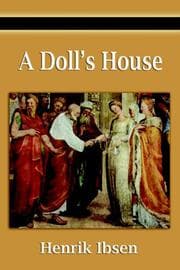
Cover of A Doll's House

A Doll's House

Henrik Ibsen

1889

A Doll's House by Henrik Ibsen portrays Nora, the wife, as a "doll," beautiful, unsophisticated, childlike, well-meaning, but ignorant of the adult world and affairs. All of her friends see her as a doll. Her husband Torvald treats her as one, calling her childish names. He tries to control all of her behavior, not because he is mean, but because he loves her and he realizes that she is unable to do so. IN "A Doll's House, Torvald" tells Nora what to eat so that her teeth will not be spoiled from sugar and how much she should spend because she does not understand much about money. And it is the latter, the money, that gets Nora into trouble. Torvald was sick some years back and needed to travel and stay in a warmer climate for some months, but the couple had no money. She, out of childish but ignorant love, borrowed money from an unscrupulous man who insisted that she have her father countersign the loan. Her father was dying, so she forged his signature on the loan document. She was certain that this was not wrong because her intentions were pure, she wanted to save her husband's life. She did not tell her husband about the loan because she childishly wanted to surprise him someday in the future and show him that she acted wisely and that she, who he thought of as childlike, saved his life. She laughed about her cleverness often when she was alone. Now the unscrupulous lender is demanding something from Nora, or he will reveal the forgery to her husband and his employer, and this will affect her marriage and her husband will lose his job. The tragedy in Henrik Ibsen's "The Doll's House" probably would not have occured if the people would have treated women properly as human beings rather than dolls.

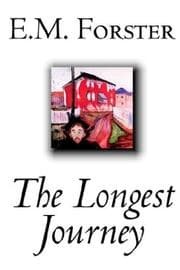
Cover of The Longest Journey

The Longest Journey

E. M. Forster

1907

Edward Morgan Forster (1 January 1879 - 7 June 1970) was an English novelist, short story writer, essayist and librettist. He is known best for his ironic and well-plotted novels examining class difference and hypocrisy in early 20th-century British society. Forster's humanistic impulse toward understanding and sympathy may be aptly summed up in the epigraph to his 1910 novel Howards End: "Only connect ... ". His 1908 novel, A Room with a View, is his most optimistic work, while A Passage to India (1924) brought him his greatest success. He was nominated for the Nobel Prize in Literature in 13 different years.

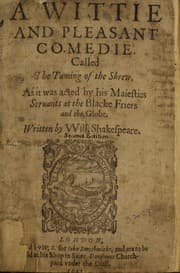
Cover of The Taming of the Shrew

The Taming of the Shrew

William Shakespeare

1631

The Wonder of Shakespeare One who reads a few of Shakespeare's great plays and then the meager story of his life is generally filled with a vague wonder. Here is an unknown country boy, poor and poorly educated according to the standards of his age, who arrives at the great city of London and goes to work at odd jobs in a theater. In a year or two he is associated with scholars and dramatists, the masters of their age, writing plays of kings and clowns, of gentlemen and heroes and noble women, all of whose lives he seems to know by intimate association. In a few years more he leads all that brilliant group of poets and dramatists who have given undying glory to the Age of Elizabeth. Play after play runs from his pen, mighty dramas of human life and character following one another so rapidly that good work seems impossible; yet they stand the test of time, and their poetry is still unrivaled in any language. For all this great work the author apparently cares little, since he makes no attempt to collect or preserve his writings. A thousand scholars have ever since been busy collecting, identifying, classifying the works which this magnificent workman tossed aside so carelessly when he abandoned the drama and retired to his native village. He has a marvelously imaginative and creative mind; but he invents few, if any, new plots or stories. He simply takes an old play or an old poem, makes it over quickly, and lo! this old familiar material glows with the deepest thoughts and the tenderest feelings that ennoble our humanity; and each new generation of men finds it more wonderful than the last. How did he do it? That is still an unanswered question and the source of our wonder.

Affiliate Disclosure: As an Amazon Associate, we may earn from qualifying purchases. Book links on this page may be affiliate links. This does not affect our recommendations or the price you pay.