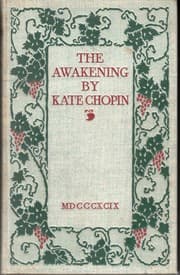
Cover of The Awakening

The Awakening

by Kate Chopin

Published 1899

'The voice of the sea is seductive; never ceasing, whispering, clamoring, murmuring, inviting the soul to wander for a spell in abysses of solitude' When 'The Awakening' was first published in 1899, charges of sordidness and immorality seemed to consign it into obscurity and irreparably damage its author's reputation. But a century after her death, it is widely regarded as Kate Chopin's great achievement. Through careful, subtle changes of style, Chopin shows the transformation of Edna Pontellier, a young wife and mother, who - with tragic consequences - refuses to be caged by married and domestic life, and claims for herself moral and erotic freedom. The Penguin English Library - collectable general readers' editions of the best fiction in English, from the eighteenth century to the end of the Second World War.

AdulteryAmerican literatureClassic LiteratureCriticism and interpretationfeminist fictionfeminist literatureFictionHistoryInterpersonal attractionInterpersonal relationsliterary fictionLouisiana Creoles

Similar Books

Cover of Pride and Prejudice

Pride and Prejudice

Jane Austen

Austen’s most celebrated novel tells the story of Elizabeth Bennet, a bright, lively young woman with four sisters, and a mother determined to marry them to wealthy men. At a party near the Bennets’ home in the English countryside, Elizabeth meets the wealthy, proud Fitzwilliam Darcy. Elizabeth initially finds Darcy haughty and intolerable, but circumstances continue to unite the pair. Mr. Darcy finds himself captivated by Elizabeth’s wit and candor, while her reservations about his character slowly vanish. The story is as much a social critique as it is a love story, and the prose crackles with Austen’s wry wit.

Cover of The Freedom of Life

The Freedom of Life

Annie Payson Call

Annie Payson Call's "The Freedom of Life" offers a practical philosophy for achieving inner peace and mental well-being by emphasizing the power of conscious thought and disciplined will. The book guides readers toward self-mastery, asserting that true freedom lies not in external circumstances but in cultivating a serene and resilient inner life through consistent self-effort and a positive outlook. Call's enduring insights provide a framework for navigating life's challenges with greater equanimity and purpose, fostering personal growth and sustained happiness.

Cover of 嫌われる勇気

嫌われる勇気

Ichirō Kishimi, Fumitake Koga

This book, framed as a dialogue between a philosopher and a youth, explores Adlerian psychology to challenge conventional notions of happiness and freedom. It argues that individuals possess the power to determine their own lives and find fulfillment not by seeking approval, but by embracing self-acceptance and understanding that all problems stem from interpersonal relationships. Through this lens, the text offers a framework for personal growth and a reevaluation of how we approach our interactions and our pursuit of a meaningful existence.

Cover of The Art of War

The Art of War

孙武 (Sun Tzu), Stephen F. Kaufman, Lionel Giles, Onésimo Colavidas

Sun Tzu's ancient treatise, "The Art of War," offers timeless strategic principles applicable beyond the battlefield to business, politics, and personal conflict. It emphasizes understanding oneself and the enemy, the importance of deception and adaptability, and the value of achieving victory with minimal confrontation. Through its concise aphorisms and insightful observations, the work provides a framework for decisive action and the cultivation of superior strategic thinking.

Cover of Great Expectations

Great Expectations

Charles Dickens

Great Expectations was first published as a weekly serial in All the Year Round, December 1860 - August 1861. Its first appearance in volume form was as three-volume novel, without illustrations, in July 1861. A one-volume edition, the next year, preceded its inclusion in the collected editions of Dickens's lifetime. The three-volume 1861 edition is the basis of the present text: variant readings, including those in manuscript and extant proofs, are recorded in the textual apparatus, providing an unusually rich source of information on Dickens's methods of composition. The Introduction traces this process of composition and draws attention to the two unperformed dramatic adaptations: the reading version and the 1861 play version, made as a safeguard of copyright. Appendices include the original ending, the author's notes, and two textual examinations, one of the five so-called `editions' of 1861, the other a comparison of the one-volume 1862 edition with the 1864 Library edition.

Cover of Dangerous sexualities

Dangerous sexualities

Frank Mort

Dangerous Sexualities takes a look at how our ideas of health and disease are linked to moral and immoral notions of sex. Beginning in the 1830s, Frank Mort relates his social historical narratives to the sexual choices and possibilities facing us now. This long-awaited second edition has been thoroughly updated to include new discussions of eugenics, race hygiene and social imperialism in the late nineteenth and early twentieth centuries. With a new and extended bibliography, introduction and illustrations, this second edition brings a classic into the 21st Century.

Cover of El conde Lucanor

El conde Lucanor

Don Juan Manuel

Don Juan Manuel (1282-1348), noble directamente emparentado con las familias que durante varios siglos ocuparon el trono de Castilla, es un caso anómalo en la literatura medieval española en la que abundan las obras anónimas. Sin embargo, entre su vida pública, de la que se conserva numerosa documentación, y la imagen que de sí mismo ofrecen sus páginas hay sorprendentes contrastes. Sus ocho obras conservadas, en las que predomina la intención de adoctrinar a los jóvenes vástagos de la nobleza, lo convierten en el prosista más importante del siglo XIV. En El conde Lucanor, su obra más conocida, alcanzan culminación y síntesis las tradiciones cuentísticas del mundo oriental y de los predicadores cristianos. La popularidad obtenida por los exempla incluidos en la primera parte no debe, sin embargo, oscurecer la habilidad con que Don Juan Manuel organiza el conjunto y combina distintos recursos retóricos. La pareja formada por el conde Lucanor y su ayo Patronio traspasa con sorprendente modernidad los borrosos límites que separan la realidad de la fición y entra por derecho propio a formar parte de los personajes famosos de la literatura universal.

Cover of The Development of the Theatre

The Development of the Theatre

Allardyce Nicoll

Allardyce Nicoll's comprehensive survey traces the evolution of theatrical performance across Western civilization, from its ancient Greek origins through to the early 20th century. The book meticulously details the changing architectural designs of theaters, the innovations in stagecraft and scenery, and the development of dramatic forms and acting styles. Nicoll provides a rich historical context, demonstrating how societal shifts and cultural influences shaped theatrical presentation and the very nature of dramatic art.

Explore More

Affiliate Disclosure: As an Amazon Associate, we may earn from qualifying purchases. Book links on this page may be affiliate links. This does not affect our recommendations or the price you pay.