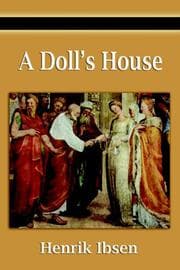

Cover of A Doll's House

A Doll's House

by Henrik Ibsen

Published 1889

A Doll's House by Henrik Ibsen portrays Nora, the wife, as a "doll," beautiful, unsophisticated, childlike, well-meaning, but ignorant of the adult world and affairs. All of her friends see her as a doll. Her husband Torvald treats her as one, calling her childish names. He tries to control all of her behavior, not because he is mean, but because he loves her and he realizes that she is unable to do so. IN "A Doll's House, Torvald" tells Nora what to eat so that her teeth will not be spoiled from sugar and how much she should spend because she does not understand much about money. And it is the latter, the money, that gets Nora into trouble. Torvald was sick some years back and needed to travel and stay in a warmer climate for some months, but the couple had no money. She, out of childish but ignorant love, borrowed money from an unscrupulous man who insisted that she have her father countersign the loan. Her father was dying, so she forged his signature on the loan document. She was certain that this was not wrong because her intentions were pure, she wanted to save her husband's life. She did not tell her husband about the loan because she childishly wanted to surprise him someday in the future and show him that she acted wisely and that she, who he thought of as childlike, saved his life. She laughed about her cleverness often when she was alone. Now the unscrupulous lender is demanding something from Nora, or he will reveal the forgery to her husband and his employer, and this will affect her marriage and her husband will lose his job. The tragedy in Henrik Ibsen's "The Doll's House" probably would not have occured if the people would have treated women properly as human beings rather than dolls.

DramaTranslations into EnglishWivesNorwegian dramaTranslations from NorwegianHusband and wifeEnglish dramaMan-woman relationshipsMarriageWomen's rightsWomenContinental european drama (dramatic works by one author)

Similar Books

Cover of The Awakening

The Awakening

Kate Chopin

'The voice of the sea is seductive; never ceasing, whispering, clamoring, murmuring, inviting the soul to wander for a spell in abysses of solitude' When 'The Awakening' was first published in 1899, charges of sordidness and immorality seemed to consign it into obscurity and irreparably damage its author's reputation. But a century after her death, it is widely regarded as Kate Chopin's great achievement. Through careful, subtle changes of style, Chopin shows the transformation of Edna Pontellier, a young wife and mother, who - with tragic consequences - refuses to be caged by married and domestic life, and claims for herself moral and erotic freedom. The Penguin English Library - collectable general readers' editions of the best fiction in English, from the eighteenth century to the end of the Second World War.

Cover of Corinne

Corinne

Germaine de Staël, Isabel Hill, Albertine-Adrienne Necker de Saussure, Charles Augustin Sainte-Beuve, L. E. L., Arthur Manderley, Isabel Hill, Creative Commons, Necker de Saussure

Germaine de Staël's *Corinne* offers a sweeping Romantic panorama, following the brilliant, unconventional poet Corinne as she navigates love and societal expectations in picturesque Italy. Through Corinne's passionate intellect and her complex relationship with the English nobleman Oswald, the novel delves into a profound psychological study of ambition, artistic genius, and the constraints placed upon women. The narrative also enriches its exploration of these themes with vivid descriptions of Italian landscapes and culture, contrasting them with the more reserved English sensibility, all within a compelling fictional framework.

Cover of Misalliance

Misalliance

George Bernard Shaw

George Bernard Shaw was born in Dublin in 1856. Before becoming a playwright he wrote music and literary criticism. Shaw used his writing to attack social problems such as education, marriage, religion, government, health care, and class privilege. Shaw was particularly conscious of the exploitation of the working class Misalliance is a 1909 house-comedy. There is a clash between social classes when an Edwardian aristocrat wants to marry the daughter of an underwear tycoon. The entire play takes place in an afternoon in a Victorian drawing room.

Cover of The Taming of the Shrew

The Taming of the Shrew

William Shakespeare

The Wonder of Shakespeare One who reads a few of Shakespeare's great plays and then the meager story of his life is generally filled with a vague wonder. Here is an unknown country boy, poor and poorly educated according to the standards of his age, who arrives at the great city of London and goes to work at odd jobs in a theater. In a year or two he is associated with scholars and dramatists, the masters of their age, writing plays of kings and clowns, of gentlemen and heroes and noble women, all of whose lives he seems to know by intimate association. In a few years more he leads all that brilliant group of poets and dramatists who have given undying glory to the Age of Elizabeth. Play after play runs from his pen, mighty dramas of human life and character following one another so rapidly that good work seems impossible; yet they stand the test of time, and their poetry is still unrivaled in any language. For all this great work the author apparently cares little, since he makes no attempt to collect or preserve his writings. A thousand scholars have ever since been busy collecting, identifying, classifying the works which this magnificent workman tossed aside so carelessly when he abandoned the drama and retired to his native village. He has a marvelously imaginative and creative mind; but he invents few, if any, new plots or stories. He simply takes an old play or an old poem, makes it over quickly, and lo! this old familiar material glows with the deepest thoughts and the tenderest feelings that ennoble our humanity; and each new generation of men finds it more wonderful than the last. How did he do it? That is still an unanswered question and the source of our wonder.


Cover of The climacteric in perspective

The climacteric in perspective

International Congress on the Menopause (4th 1984 Lake Buena Vista, Fla.), M. Notelovitz, P.A. van Keep

The Fourth International Congress on the Menopause was held in Lake Buena Vista, Florida, USA in October - November 1984. It was different from the previous meetings held under the auspices of the International Menopause Society in three respects: the duration of the Congress was extended to five days, plenary sessions were held on each day, and the scope of the subject matter was expanded to provide a total or holistic overview of the subject - hence the theme for the Congress 'Climacteric Medicine and Science: A Societal need. ' In recent years there has been an increased interest in the menopause and middle year aging by scientists and clinicians in fields as diverse as anthropology, urodynamics, nutrition and exercise physiology, while 'newer' issues in clinical medicine, such as osteoporosis prevention and management, attracted specialists in nuclear immaging techniques and internal medicine. Over 120 invited speakers plus numerous contributors to the free communication, special lectures and the poster sessions provided a virtual cornucopia of information on the menopause, that has indeed brought a newer perspective to a subject previously the domain of a single specialty, the gynecologist, and dominated by a single therapy, estrogen replacement.

Cover of Married women who love women

Married women who love women

Carren Strock

This book is about women in heterosexual marriages who discover or come to terms with their lesbianism or bisexuality. It answers questions such as how women make this discovery, what they do once they realize their same-gender sexuality, how family and friends deal with the situation, and what happens to marriages and families. This second edition contains a new introduction, three new chapters, a glossary of gay-related terms, and a new list of additional reading.

Cover of Great Expectations

Great Expectations

Charles Dickens

Great Expectations was first published as a weekly serial in All the Year Round, December 1860 - August 1861. Its first appearance in volume form was as three-volume novel, without illustrations, in July 1861. A one-volume edition, the next year, preceded its inclusion in the collected editions of Dickens's lifetime. The three-volume 1861 edition is the basis of the present text: variant readings, including those in manuscript and extant proofs, are recorded in the textual apparatus, providing an unusually rich source of information on Dickens's methods of composition. The Introduction traces this process of composition and draws attention to the two unperformed dramatic adaptations: the reading version and the 1861 play version, made as a safeguard of copyright. Appendices include the original ending, the author's notes, and two textual examinations, one of the five so-called `editions' of 1861, the other a comparison of the one-volume 1862 edition with the 1864 Library edition.

Explore More

Affiliate Disclosure: As an Amazon Associate, we may earn from qualifying purchases. Book links on this page may be affiliate links. This does not affect our recommendations or the price you pay.