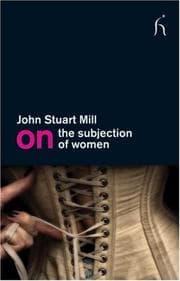

Cover of The Subjection of Women

The Subjection of Women

by John Stuart Mill

Published 1869

Women's rightsWomenLegal status, lawsHistoryEqualityWomen, history, modern period, 1600-Social and moral questionsÉgalité (Sociologie)Man-woman relationshipsDroitsRelations entre hommes et femmesFemmes

Similar Books

Cover of The second Mrs. Tanqueray

The second Mrs. Tanqueray

Arthur Wing Pinero

Aubrey Tanqueray's Chambers in the Albany-a richly and tastefully decorated room, elegantly and luxuriously furnished: on the right a large pair of doors opening into another room, on the left at the further end of the room a small door leading to a bedchamber. A circular table is laid for a dinner for four persons which has now reached the stage of dessert and coffee. Everything in the apartment suggests wealth and refinement. The fire is burning brightly. Aubrey Tanqueray, Misquith, and Jayne are seated at the dinner-table. Aubrey is forty-two, handsome, winning in manner, his speech and bearing retaining some of the qualities of young-manhood. Misquith is about forty-seven, genial and portly. Jayne is a year or two Misquith's senior; soft-speaking and precise-in appearance a type of the prosperous town physician. Morse, Aubrey's servant, places a little cabinet of cigars and the spirit-lamp on the table beside Aubrey, and goes out.

Cover of Letters on the improvement of the mind

Letters on the improvement of the mind

Hester Chapone, Chapone, Thomas Enquiry into the Duties of the Female Sex Gisborne

This collection of works by John Gregory, Lady Sarah Pennington, and Mrs. Chapone offers a fascinating glimpse into the self-improvement literature of the late 18th century. With a focus on education, family life, and personal growth, these texts provide valuable historical context for modern readers. This work has been selected by scholars as being culturally important, and is part of the knowledge base of civilization as we know it. This work is in the "public domain in the United States of America, and possibly other nations. Within the United States, you may freely copy and distribute this work, as no entity (individual or corporate) has a copyright on the body of the work. Scholars believe, and we concur, that this work is important enough to be preserved, reproduced, and made generally available to the public. We appreciate your support of the preservation process, and thank you for being an important part of keeping this knowledge alive and relevant.

Cover of Man and Wife

Man and Wife

Wilkie Collins, Norman Page, Harry A. Webber

Man and Wife was Wilkie Collins' ninth published novel. It is the second of his novels (after No Name) in which social questions provide the main impetus of the plot. Collins increasingly used his novels to explore social abuses, which according to critics] tends to detract from their qualities as fiction. The social issue which drives the plot is the state of Scots marriage law; at the time the novel was written, any couple who were legally entitled to marry and who asserted that they were married before witnesses, or in writing, were regarded in Scotland as being married in law. The novel has a complex plot, common in Collins' work.[3] In a Prologue, a selfish and ambitious man casts off his wife in order to marry a wealthier and better-connected woman, by taking advantage of a loophole in the marriage laws of Ireland.The initial action takes place in the widowed Lady Lundie's house in Scotland. Geoffrey Delamayn has promised marriage to his lover Anne Silvester (governess to Lady Lundie's stepdaughter Blanche), who has incurred the enmity of her employer. The spendthrift Geoffrey is about to be disinherited and wishes to escape from his promise and marry a wealthy wife. Nevertheless, he is obliged to arrange a rendezvous with Anne, in the character of his wife, at an inn, and documents this in an exchange of notes with her. Subsequently, urgent matters force him to send his friend Arnold Brinkworth, Blanche's fiancé, to Anne in his place. To gain access to her, Arnold must ask for "his wife". Although nothing improper passes between them, they appear to the landlady and to Bishopriggs, a waiter, to be man and wife.Thus, both Geoffrey and Arnold might be deemed to be married to Anne, depending on the weight put on the spoken and written evidence. Most of the novel concerns Anne's, Geoffrey's and Arnold's attempts to clarify their marital status:

Cover of A Doll's House

A Doll's House

Henrik Ibsen

A Doll's House by Henrik Ibsen portrays Nora, the wife, as a "doll," beautiful, unsophisticated, childlike, well-meaning, but ignorant of the adult world and affairs. All of her friends see her as a doll. Her husband Torvald treats her as one, calling her childish names. He tries to control all of her behavior, not because he is mean, but because he loves her and he realizes that she is unable to do so. IN "A Doll's House, Torvald" tells Nora what to eat so that her teeth will not be spoiled from sugar and how much she should spend because she does not understand much about money. And it is the latter, the money, that gets Nora into trouble. Torvald was sick some years back and needed to travel and stay in a warmer climate for some months, but the couple had no money. She, out of childish but ignorant love, borrowed money from an unscrupulous man who insisted that she have her father countersign the loan. Her father was dying, so she forged his signature on the loan document. She was certain that this was not wrong because her intentions were pure, she wanted to save her husband's life. She did not tell her husband about the loan because she childishly wanted to surprise him someday in the future and show him that she acted wisely and that she, who he thought of as childlike, saved his life. She laughed about her cleverness often when she was alone. Now the unscrupulous lender is demanding something from Nora, or he will reveal the forgery to her husband and his employer, and this will affect her marriage and her husband will lose his job. The tragedy in Henrik Ibsen's "The Doll's House" probably would not have occured if the people would have treated women properly as human beings rather than dolls.

Cover of Estrogen

Estrogen

Lila Nachtigall, Lila, MD Nachtigall, Joan Rattner Heilman, Lila E. Nachtigall

En la actualidad, la terapia de sustitución hormonal suscita un notable desconcierto y confusión en multitud de mujeres e incluso entre los médicos. Si se sigue correctamente, el tratamiento con estrógenos constituye uno de los medios más eficaces para afrontar los cambios físicos que sobrevienen en la mujer a lo largo de la menopausia, desde los sofocos y el insomnio hasta el entumecimiento de manos y pies. Esta guía, que incluye las investigaciones científicas más recientes, así como las terapias alternativas de que se dispone, ofrece información sobre la eficacia del tratamiento hormonal --junto con sus efectos secundarios y posibles problemas-- para aliviar los síntomas de la menopausia, prevenir la osteoporosis, mejorar la memoria, mantener una vida sexual activa y reducir la probabilidad de desarrollar la enfermedad de Alzheimer o un infarto de miocardio.

Affiliate Disclosure: As an Amazon Associate, we may earn from qualifying purchases. Book links on this page may be affiliate links. This does not affect our recommendations or the price you pay.