Books Like “The Secret of Happy Children

If you enjoyed The Secret of Happy Children by Steve Biddulph, you likely appreciate Parent and child, Behavior modification, Child rearing. These similar reads match the tone, themes, and audience of the original.

Parent and childBehavior modificationChild rearingParentingChild psychologyPsychologyParenting and child careFamilies
Cover of What to expect the first year

What to expect the first year

Heidi Murkoff, Arlene Eisenberg, Sandee E. Hathaway

1989

Now fully revised and updated, this comprehensive and practical month-by-month guide clearly explains everything parents need to know - or might be worrying about - in the first year with a new baby. Featuring special sections on older siblings, travelling with a baby, adopted babies, and specific problems, as well as a first aid guide and charts on monthly growth and development, feeding and sleeping habits, this is the only book on infant care to address both the physical and the emotional needs of the whole family. Covering the most up-to-date knowledge, both medical and developmental, WHAT TO EXPECT THE 1st YEAR is, above all, down-to-earth and reassuring - and an invaluable aid for all parents of new babies.

Cover of Handbook of Parenting

Handbook of Parenting

Marc H. Bornstein

1995

This highly anticipated third edition of the Handbook of Parentingbrings together an array of field-leading experts who have worked in different ways toward understanding the many diverse aspects of parenting. Contributors to the Handbooklook to the most recent research and thinking to shed light on topics every parent, professional, and policymaker wonders about. Parenting is a perennially "hot" topic. After all, everyone who has ever lived has been parented, and the vast majority of people become parents themselves. No wonder bookstores house shelves of "how-to" parenting books and magazine racks in pharmacies and airports overflow with periodicals that feature parenting advice. However, almost none of these is evidence-based. The Handbook of Parentingis. Period. Each chapter has been written to be read and absorbed in a single sitting, and includes historical considerations of the topic, a discussion of central issues and theory, a review of classical and modern research, and forecasts of future directions of theory and research. Together, the five volumes in the Handbookcover Children and Parenting, the Biology and Ecology of Parenting, Being and Becoming a Parent, Social Conditions and Applied Parenting, and the Practice of Parenting. Volume 1, Children and Parenting,considers parenthood as a functional status in the life cycle: Parents protect, nurture, and teach their progeny, even if human development is more dynamic than can be determined by parental caregiving alone. Volume 1 of the Handbook of Parentingbegins with chapters concerned with how children influence parenting. Notable are their more obvious characteristics, like child age or developmental stage; but subtler ones, like child gender, physical state, temperament, mental ability, and other individual-differences factors, are also instrumental. The chapters in Part I, on Parenting across the Lifespan, discuss the unique rewards and special demands of parenting children of different ages and stages -

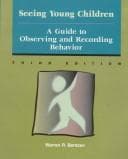
Cover of Seeing young children

Seeing young children

Warren R. Bentzen

1985

Seeing Young Children is an extensive guide to observing and recording behavior in children from birth through age eight. It begins by addressing the basic meaning of observation and why it is so important. This includes a discussion of the theoretical and practical aspects of observing and recording behavior. Detailed information on development, behavior and functioning in children in this age group enables parents and professionals to make meaningful observation, recordings, and evaluations. A large portion of the book concentrates on in-depth reviews of recording techniques and instruments, as well as the advantages and disadvantages of each. Finally, the last five chapters offer a wealth of observation exercises readers can immediately put to use. Specific by age group, each of these chapters contains observation objectives, instructions as to procedure, and background information on many functional areas, all aimed at collecting and using quality data to the benefit of children.

Cover of Toughlove

Toughlove

Phyllis York

1980

How do you love an “impossible” teenager? “An effective way of uniting parents to square off against the youngsters’ own powerful peer group that endorses drugtaking and rebelliousness.”—Time Thousands of parents are finding new hope in dealing with rebellious teenagers through Toughlove, a self-help program which has grown to over eight hundred groups throughout the United States and Canada in less than six years. Now, for the first time in book form, the founders tell how Toughlove works. “You need Toughlove if you feel helpless and unable to cope with your teenagers’ behavior or if you feel victimized by them, disappointed in yourself as a parent, guilty because you think you have done a rotten job and are frightened bythe potential for violence in yourself and your children. . . . Remember, you have the right to a night’s sleep without where your kid is—or being awakened by a phone call from the police or a hospital or a drunk teenager who’s stranded somewhere.”—Ann Landers

Cover of Parent-child relations

Parent-child relations

Jerry J. Bigner, Clara J. Gerhardt

1979

Now in the Ninth Edition, Jerry Bigner's "Parent-Child Relations," the classic resource for child development professionals and parents themselves, has undergone a thorough revision anchored by the vision of the late Dr. Bigner and executed by new co-author, Clara Gerhardt.Maintaining its fundamental structure and unique approach, the text uses family systems and systemic family development theory as a framework to explore how parent-child relations change in tandem with developmental changes occurring with children, adults, and the wider family system. Thoughtful updates and revisions were done to increase the effectiveness and currency of the text. The text continues to provide strong emphasis on various theoretical and practical models pertaining to parenting. For decades now, this classic text has prepared countless teachers and practitioners by its proven and practical approach, utilizing family systems and systemic family development theory to explore how parent-child relations change in tandem with developmental changes occurring with children, adults, and the wider family system. The most comprehensive and current resource available to students as they prepare for working with parents and families, and for their roles as parents themselves, this best-selling resource carries on the essential message of its originator, Dr. Jerry Bigner, and will continue to nurture future family scholars and practitioners for years to come.

Cover of Positive child guidance

Positive child guidance

Darla Ferris Miller

1990

POSITIVE CHILD GUIDANCE, Eighth Edition, is ideal for guidance, behavior management and discipline, and classroom management courses in an early childhood education curriculum. This practical book outlines workable steps for creating a cooperative, respectful community of children and adults with special emphasis on sensitivity to cultural needs, cultural differences, and developmentally appropriate practice. Students will learn a range of practical, effective, and flexible guidance strategies based on principles of straightforward communication and assertiveness. This new edition includes critical advances in research and addresses the cultural trends that are changing the way babies and children are cared for today. Important Notice: Media content referenced within the product description or the product text may not be available in the ebook version.

Cover of Your child at play

Your child at play

Marilyn M. Segal

1985

Packed with learning activities, games, poems, and recipes, as well as anecdotes and advice, the eight sections focus on: Individual Differences and Common Threads (distinguishing between real and pretend; concern with fairness; self-awareness) The Questions Children Ask (the physical world; the natural world; the social world) Friends (best friends; controversies and conflicts; sibling play) Active Play (contact and cuddling; physical feats; sports) Creative Play (music; art; crafts; storytelling and jokes) Pretend Play (actor play and dressing up; imaginary playmates; reemergence of pretending) School Play (reading; writing; arithmetic; collecting facts; science) Family (attachment and separation; family continuity; traditions)

Cover of Building resilience in children and teens

Building resilience in children and teens

Kenneth R. Ginsburg, Martha M. Jablow

2005

Confronting the overwhelming amount of stress kids face today, this invaluable guide offers coping strategies for facing the combined elements of academic performance, high achievement standards, media messages, peer pressure, and family tension. The handbook acknowledges that adolescents commonly survive stress by either indulging in unhealthy behaviors or giving up completely, and its suggested solutions are aimed at strengthening resilience. The proposed plan enables kids from the age of 18 months to 18 years to build the seven crucial "C's"--Competence, confidence, connection, character, co.

Cover of 1-2-3 magic

1-2-3 magic

Thomas W. Phelan

1995

America's #1 child discipline book for over 20 years 1-2-3 Magic has helped millions of parents, teachers, and caregivers all over the world establish an effective, appropriate discipline system that helps children listen better and motivate themselves to behave well. Dr. Thomas Phelan is an internationally renowned expert in his field and has broken down the elements of effective parenting into an easy-to-understand program that can work for any family or in a classroom or caregiving scenario. Recommended by parenting experts for over twenty years, 1-2-3 Magic is a cornerstone book in the parenting category that combines timeless advice with fresh, up-to-date anecdotes and content, and is a must-have book for any caregiver hoping to raise happy, healthy, responsible kids.

Cover of Human motivation

Human motivation

Bernard Weiner

1980

`Weiner's third textbook on motivation has more emphasis on emotion than its predecessors. There is also a new organization around basic metaphors... there is particularly good and up-to-date coverage of attributional approaches' - Cognition and Emotion Successful with over 24,000 students in two earlier motivation books, Weiner's text - newly available in paperback - depicts motivation as an unfolding story with plot and characters. He offers insights into the history and study of motivation and captures the excitement of the field as it evolves. Theories are explored in the context of the dominant metaphor, or paradigm, of various eras. First to be discussed is the machine metaphor, which to

Cover of Das Drama des begabten Kindes und die Suche nach dem wahren Selbst

Das Drama des begabten Kindes und die Suche nach dem wahren Selbst

Alice Miller

1979

The “drama” of the gifted—i.e., sensitive, alert—child consists of his recognition at a very early age of his parents' needs and of his adaptation to those needs. In the process, he learns to repress rather than to acknowledge his own intense feelings because they are unacceptable to his parents. Although it will not always be possible to avoid these “ugly” feelings (anger, indignation, despair, jealousy, fear) in the future, they will split off, and the most vital part of the “true self” (a key phrase in Alice Miller's works) will not be integrated into the personality. This leads to emotional insecurity and loss of self, which are revealed in depression or concealed behind a facade of grandiosity.Alice Miller defines the ideal state of genuine vitality, of free access to the true self and to authentic individual feelings that have their roots in childhood, as “healthy narcissism.” Narcissistic disturbances, on the other hand, represent for her solitary confinement of the true self within the prison of the false self. This is regarded less as an illness than as a tragedy.The examples Alice Miller presents make us aware of the child's unarticulated suffering and of the tragedy of parents who are unavailable to their children—the same parents who, when they were children, were available to fill their parents' needs. In her psychoanalytical work, Dr. Miller found that her patients' ability to experience authentic feelings, especially feelings of sadness, had been for the most part destroyed; it was her task to help her patients try to regain that long-lost capacity for genuine feelings that is the source of natural vitality. Many people who have read her books have discovered within themselves for the first time in their lives the little child they once were. This may explain the unusually strong and deep reactions Alice Miller's books have evoked in so many readers from different countries. The Drama of the Gifted Child and the Search for the True Self is the origina

Cover of Concerning children

Concerning children

Charlotte Perkins Gilman, Jon A. Lindseth Suffrage Collection, Rationalist Press Association

1900

Charlotte Perkins Gilman's Concerning Children reflects her innovative thinking on the social and economic construction of motherhood. In this volume, she takes on American society at its core principles: the betterment of our society through the development of our children. Gilman attacks our conventional model of child rearing, one based on obedience and discipline, rather than on the development of creativity and individuality. She responds to popular practices such as the corporal punishment of children, and proposes new and radical ways of child-rearing including social motherhood, which frees women to pursue careers. Presciently observing more than a century ago that it takes an entire village to raise a child, Gilman's Concerning Children is a must-read for anyone interested in gender and family studies.

Frequently Asked Questions

What should I read after The Secret of Happy Children?
Browse the similar books below — they're matched by subject overlap, author style, and reader preferences.
What books are most similar to The Secret of Happy Children?
Our recommendations prioritize shared themes like Parent and child, Behavior modification, Child rearing and books enjoyed by similar readers.
Which similar book is best for beginners?
Check page counts and summaries on each recommendation. Shorter titles with broader appeal are usually the best starting point.

Promote Your Book on BestsellerFinder

Reach thousands of readers with featured placements, homepage spots, and newsletter features.

Get bestseller picks in your inbox

Weekly curated book recommendations. Unsubscribe anytime.

Explore More

Affiliate Disclosure: As an Amazon Associate, we may earn from qualifying purchases. Book links on this page may be affiliate links. This does not affect our recommendations or the price you pay.