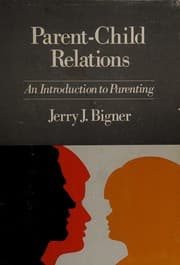
Cover of Parent-child relations

Parent-child relations

by Jerry J. Bigner, Clara J. Gerhardt

Published 1979

Now in the Ninth Edition, Jerry Bigner's "Parent-Child Relations," the classic resource for child development professionals and parents themselves, has undergone a thorough revision anchored by the vision of the late Dr. Bigner and executed by new co-author, Clara Gerhardt.Maintaining its fundamental structure and unique approach, the text uses family systems and systemic family development theory as a framework to explore how parent-child relations change in tandem with developmental changes occurring with children, adults, and the wider family system. Thoughtful updates and revisions were done to increase the effectiveness and currency of the text. The text continues to provide strong emphasis on various theoretical and practical models pertaining to parenting. For decades now, this classic text has prepared countless teachers and practitioners by its proven and practical approach, utilizing family systems and systemic family development theory to explore how parent-child relations change in tandem with developmental changes occurring with children, adults, and the wider family system. The most comprehensive and current resource available to students as they prepare for working with parents and families, and for their roles as parents themselves, this best-selling resource carries on the essential message of its originator, Dr. Jerry Bigner, and will continue to nurture future family scholars and practitioners for years to come.

FamiliesFamilyParentingChild developmentParent and childDomestic relationsChild development

Similar Books

Cover of Novels (Emma / Mansfield Park / Northanger Abbey / Persuasion / Pride and Prejudice / Sense and Sensibility)

Novels (Emma / Mansfield Park / Northanger Abbey / Persuasion / Pride and Prejudice / Sense and Sensibility)

Jane Austen

This collection from Everyman's Library provides the complete works of one of the most popular authors in English literature. Each of Jane Austen's masterpieces is enchantingly funny, touchingly and wittily told, and filled with a dazzling gallery of characters. These beautiful, clothbound classics are essentials for any home library. Titles included: Emma, Mansfield Park, Northanger Abby, Persuasion, Pride and Prejudice, Sandition and Other Stories, Sense and Sensibility

Cover of A Doll's House

A Doll's House

Henrik Ibsen

A Doll's House by Henrik Ibsen portrays Nora, the wife, as a "doll," beautiful, unsophisticated, childlike, well-meaning, but ignorant of the adult world and affairs. All of her friends see her as a doll. Her husband Torvald treats her as one, calling her childish names. He tries to control all of her behavior, not because he is mean, but because he loves her and he realizes that she is unable to do so. IN "A Doll's House, Torvald" tells Nora what to eat so that her teeth will not be spoiled from sugar and how much she should spend because she does not understand much about money. And it is the latter, the money, that gets Nora into trouble. Torvald was sick some years back and needed to travel and stay in a warmer climate for some months, but the couple had no money. She, out of childish but ignorant love, borrowed money from an unscrupulous man who insisted that she have her father countersign the loan. Her father was dying, so she forged his signature on the loan document. She was certain that this was not wrong because her intentions were pure, she wanted to save her husband's life. She did not tell her husband about the loan because she childishly wanted to surprise him someday in the future and show him that she acted wisely and that she, who he thought of as childlike, saved his life. She laughed about her cleverness often when she was alone. Now the unscrupulous lender is demanding something from Nora, or he will reveal the forgery to her husband and his employer, and this will affect her marriage and her husband will lose his job. The tragedy in Henrik Ibsen's "The Doll's House" probably would not have occured if the people would have treated women properly as human beings rather than dolls.

Affiliate Disclosure: As an Amazon Associate, we may earn from qualifying purchases. Book links on this page may be affiliate links. This does not affect our recommendations or the price you pay.