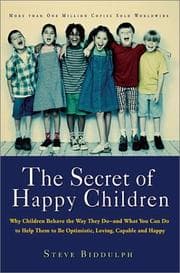

Cover of The Secret of Happy Children

The Secret of Happy Children

by Steve Biddulph

Published 1984

A guide to parent-child communication from babyhood through the teenage years explains what occurs from a child's perspective and what to do about it, covering such topics as tantrums, shyness, and the link between food and behavior.

Parent and childBehavior modificationChild rearingParentingChild psychologyPsychologyParenting and child careFamiliesChild and youth studies

Similar Books

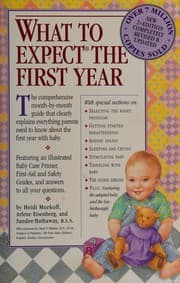
Cover of What to expect the first year

What to expect the first year

Heidi Murkoff, Arlene Eisenberg, Sandee E. Hathaway

Now fully revised and updated, this comprehensive and practical month-by-month guide clearly explains everything parents need to know - or might be worrying about - in the first year with a new baby. Featuring special sections on older siblings, travelling with a baby, adopted babies, and specific problems, as well as a first aid guide and charts on monthly growth and development, feeding and sleeping habits, this is the only book on infant care to address both the physical and the emotional needs of the whole family. Covering the most up-to-date knowledge, both medical and developmental, WHAT TO EXPECT THE 1st YEAR is, above all, down-to-earth and reassuring - and an invaluable aid for all parents of new babies.

Cover of Handbook of Parenting

Handbook of Parenting

Marc H. Bornstein

This highly anticipated third edition of the Handbook of Parentingbrings together an array of field-leading experts who have worked in different ways toward understanding the many diverse aspects of parenting. Contributors to the Handbooklook to the most recent research and thinking to shed light on topics every parent, professional, and policymaker wonders about. Parenting is a perennially "hot" topic. After all, everyone who has ever lived has been parented, and the vast majority of people become parents themselves. No wonder bookstores house shelves of "how-to" parenting books and magazine racks in pharmacies and airports overflow with periodicals that feature parenting advice. However, almost none of these is evidence-based. The Handbook of Parentingis. Period. Each chapter has been written to be read and absorbed in a single sitting, and includes historical considerations of the topic, a discussion of central issues and theory, a review of classical and modern research, and forecasts of future directions of theory and research. Together, the five volumes in the Handbookcover Children and Parenting, the Biology and Ecology of Parenting, Being and Becoming a Parent, Social Conditions and Applied Parenting, and the Practice of Parenting. Volume 1, Children and Parenting,considers parenthood as a functional status in the life cycle: Parents protect, nurture, and teach their progeny, even if human development is more dynamic than can be determined by parental caregiving alone. Volume 1 of the Handbook of Parentingbegins with chapters concerned with how children influence parenting. Notable are their more obvious characteristics, like child age or developmental stage; but subtler ones, like child gender, physical state, temperament, mental ability, and other individual-differences factors, are also instrumental. The chapters in Part I, on Parenting across the Lifespan, discuss the unique rewards and special demands of parenting children of different ages and stages -

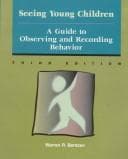
Cover of Seeing young children

Seeing young children

Warren R. Bentzen

Seeing Young Children is an extensive guide to observing and recording behavior in children from birth through age eight. It begins by addressing the basic meaning of observation and why it is so important. This includes a discussion of the theoretical and practical aspects of observing and recording behavior. Detailed information on development, behavior and functioning in children in this age group enables parents and professionals to make meaningful observation, recordings, and evaluations. A large portion of the book concentrates on in-depth reviews of recording techniques and instruments, as well as the advantages and disadvantages of each. Finally, the last five chapters offer a wealth of observation exercises readers can immediately put to use. Specific by age group, each of these chapters contains observation objectives, instructions as to procedure, and background information on many functional areas, all aimed at collecting and using quality data to the benefit of children.

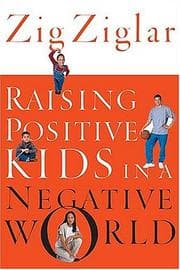
Cover of Raising Positive Kids in a Negative World

Raising Positive Kids in a Negative World

Zig Ziglar

This book offers parents practical strategies rooted in Zig Ziglar's principles for cultivating a positive mindset and strong character in children, even amidst societal challenges. It focuses on equipping parents with tools to foster self-esteem, resilience, and a sense of responsibility in their children. The advice emphasizes building a nurturing home environment that reinforces positive values and empowers children to navigate a complex world with confidence.

Cover of Blink

Blink

Malcolm Gladwell

Drawing on cutting-edge neuroscience and psychology and displaying all of the brilliance that made The Tipping Point a classic, Blink changes the way you'll understand every decision you make. Never again will you think about thinking the same way. Malcolm Gladwell redefined how we understand the world around us. Now, in Blink, he revolutionizes the way we understand the world within. Blink is a book about how we think without thinking, about choices that seem to be made in an instant - in the blink of an eye - that actually aren't as simple as they seem. Why are some people brilliant decision makers, while others are consistently inept? Why do some people follow their instincts and win, while others end up stumbling into error? How do our brains really work - in the office, in the classroom, in the kitchen, and in the bedroom? And why are the best decisions often those that are impossible to explain to others? In Blink we meet the psychologist who has learned to predict whether a marriage will last, based on a few minutes of observing a couple; the tennis coach who knows when a player will double-fault before the racket even makes contact with the ball; the antiquities experts who recognize a fake at a glance. Here, too, are great failures of "blink": the election of Warren Harding; "New Coke"; and the shooting of Amadou Diallo by police. Blink reveals that great decision makers aren't those who process the most information or spend the most time deliberating, but those who have perfected the art of "thin-slicing" - filtering the very few factors that matter from an overwhelming number of variables. Drawing on cutting-edge neuroscience and psychology and displaying all of the brilliance that made The Tipping Point a classic, Blink changes the way you understand every decision you make. Never again will you think about thinking the same way.

Cover of The Power of Your Subconscious Mind

The Power of Your Subconscious Mind

Joseph Murphy

He visto cómo les ocurren milagros a hombres y mujeres de toda condición alrededor del planeta. Los milagros también le ocurrirán a usted cuando comience a utilizar el poder mágico de su mente subconsciente. Este libro se propone enseñarle que su manera habitual de pensar y los esquemas de su imaginación configuran y crean su destino; pues lo que el hombre piensa en su mente inconsciente que es, eso es. ¿Por qué un hombre está triste y otro alegre? ¿Por qué un hombre es jubiloso y próspero, y otro, pobre y mísero? ¿Por qué un hombre está temeroso y lleno de ansiedad y otro exuda fe y confianza? ¿Por qué un hombre tiene una hermosa y elegante mansión mientras que otro arrastra una mezquina existencia en un barrio miserable? ¿Por qué un hombre constituye todo un éxito mientras que otro es un desgraciado fracaso?¿Por qué un orador se distingue y es inmensamente popular, y otro mediocre e impopular? ¿Por qué un hombre es un genio en su trabajo mientras que otro se mata trabajando toda su vida sin hacer ni conseguir nada que valga realmente la pena? ¿Por qué sana un hombre de una de esas llamadas enfermedades incurables y otro no? ¿Por qué tanta gente religiosa, que es bondadosa y amable, sufre los tormentos de los condenados en cuerpo y alma? ¿Por qué tanta gente inmoral e impía tiene éxito, y prospera, y goza de radiante salud? ¿Por qué una mujer tiene un matrimonio feliz y su hermana es desgraciada y está llena de frustraciones?¿Existe una respuesta a estas interrogantes en las operaciones mente consciente y su mente subconsciente? Indudablemente que sí. Los objetivos específicos son: contestar y aclarar las preguntas anteriores y muchas otras de naturaleza semejante. Dr.Joseph Murphy

Explore More

Affiliate Disclosure: As an Amazon Associate, we may earn from qualifying purchases. Book links on this page may be affiliate links. This does not affect our recommendations or the price you pay.