Lady Windermere's Fan
Oscar Wilde
1890
If you enjoyed The marriage of Elinor by Margaret Oliphant, you likely appreciate Marriage, Ethics, Law. These similar reads match the tone, themes, and audience of the original.

Oscar Wilde
1890

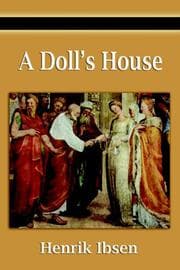
Henrik Ibsen
1889
A Doll's House by Henrik Ibsen portrays Nora, the wife, as a "doll," beautiful, unsophisticated, childlike, well-meaning, but ignorant of the adult world and affairs. All of her friends see her as a doll. Her husband Torvald treats her as one, calling her childish names. He tries to control all of her behavior, not because he is mean, but because he loves her and he realizes that she is unable to do so. IN "A Doll's House, Torvald" tells Nora what to eat so that her teeth will not be spoiled from sugar and how much she should spend because she does not understand much about money. And it is the latter, the money, that gets Nora into trouble. Torvald was sick some years back and needed to travel and stay in a warmer climate for some months, but the couple had no money. She, out of childish but ignorant love, borrowed money from an unscrupulous man who insisted that she have her father countersign the loan. Her father was dying, so she forged his signature on the loan document. She was certain that this was not wrong because her intentions were pure, she wanted to save her husband's life. She did not tell her husband about the loan because she childishly wanted to surprise him someday in the future and show him that she acted wisely and that she, who he thought of as childlike, saved his life. She laughed about her cleverness often when she was alone. Now the unscrupulous lender is demanding something from Nora, or he will reveal the forgery to her husband and his employer, and this will affect her marriage and her husband will lose his job. The tragedy in Henrik Ibsen's "The Doll's House" probably would not have occured if the people would have treated women properly as human beings rather than dolls.

Arthur Wing Pinero
1894
Aubrey Tanqueray's Chambers in the Albany-a richly and tastefully decorated room, elegantly and luxuriously furnished: on the right a large pair of doors opening into another room, on the left at the further end of the room a small door leading to a bedchamber. A circular table is laid for a dinner for four persons which has now reached the stage of dessert and coffee. Everything in the apartment suggests wealth and refinement. The fire is burning brightly. Aubrey Tanqueray, Misquith, and Jayne are seated at the dinner-table. Aubrey is forty-two, handsome, winning in manner, his speech and bearing retaining some of the qualities of young-manhood. Misquith is about forty-seven, genial and portly. Jayne is a year or two Misquith's senior; soft-speaking and precise-in appearance a type of the prosperous town physician. Morse, Aubrey's servant, places a little cabinet of cigars and the spirit-lamp on the table beside Aubrey, and goes out.

Alice Bunker Stockham
1896

Julian Hawthorne
1884
Explore the life and work of one of America's most beloved writers, Nathaniel Hawthorne. From his humble beginnings to his rise to national acclaim, readers will gain a new appreciation for the man behind such iconic works as The Scarlet Letter and The House of the Seven Gables. This work has been selected by scholars as being culturally important, and is part of the knowledge base of civilization as we know it. This work is in the "public domain in the United States of America, and possibly other nations. Within the United States, you may freely copy and distribute this work, as no entity (individual or corporate) has a copyright on the body of the work. Scholars believe, and we concur, that this work is important enough to be preserved, reproduced, and made generally available to the public. We appreciate your support of the preservation process, and thank you for being an important part of keeping this knowledge alive and relevant.

Kate Chopin
1899

Charlotte Perkins Gilman, Jon A. Lindseth Suffrage Collection, Rationalist Press Association
1900
Charlotte Perkins Gilman's Concerning Children reflects her innovative thinking on the social and economic construction of motherhood. In this volume, she takes on American society at its core principles: the betterment of our society through the development of our children. Gilman attacks our conventional model of child rearing, one based on obedience and discipline, rather than on the development of creativity and individuality. She responds to popular practices such as the corporal punishment of children, and proposes new and radical ways of child-rearing including social motherhood, which frees women to pursue careers. Presciently observing more than a century ago that it takes an entire village to raise a child, Gilman's Concerning Children is a must-read for anyone interested in gender and family studies.

Jack London
1900
The Valley of the Moon (1913) is a novel by American writer Jack London (as well as the mythic and romantic name for the wine-growing Sonoma Valley of California). The valley where it is set is located north of the San Francisco Bay Area in Sonoma County, California where Jack London was a resident; he built his ranch in Glen Ellen.The novel The Valley of the Moon is a story of a working-class couple, Billy and Saxon Roberts, struggling laborers in Oakland at the Turn-of-the-Century, who left city life behind and searched Central and Northern California for suitable farmland to own. The book is notable for its scenes in which the proletarian hero enjoys fellowship with the artists' colony in Carmel, and he settles in the Valley of the Moon.

Robert Louis Stevenson
1881

Sylvanus Stall
1901

Frances Hodgson Burnett, C. D. Williams
1901

William Somerset Maugham
1902

George Bernard Shaw
1905

Louisa May Alcott, Harriet Roosevelt Richards
1876

E. M. Forster
1907
Edward Morgan Forster (1 January 1879 - 7 June 1970) was an English novelist, short story writer, essayist and librettist. He is known best for his ironic and well-plotted novels examining class difference and hypocrisy in early 20th-century British society. Forster's humanistic impulse toward understanding and sympathy may be aptly summed up in the epigraph to his 1910 novel Howards End: "Only connect ... ". His 1908 novel, A Room with a View, is his most optimistic work, while A Passage to India (1924) brought him his greatest success. He was nominated for the Nobel Prize in Literature in 13 different years.

Edith Wharton
1910

William Dean Howells
1872
The classic books are worth reading.If you are reader, you should not miss them.You will say "Thanks" to all the classic books.

Upton Sinclair
1911
Love's Pilgrimage A Novel is one of the greatest works by Upton Sinclair. This work has been selected by scholars as being culturally important, and is part of the knowledge base of civilization.

George Bernard Shaw
1911

Guglielmo Ferrero
1911

Wilkie Collins, Norman Page, Harry A. Webber
1870
Man and Wife was Wilkie Collins' ninth published novel. It is the second of his novels (after No Name) in which social questions provide the main impetus of the plot. Collins increasingly used his novels to explore social abuses, which according to critics] tends to detract from their qualities as fiction. The social issue which drives the plot is the state of Scots marriage law; at the time the novel was written, any couple who were legally entitled to marry and who asserted that they were married before witnesses, or in writing, were regarded in Scotland as being married in law. The novel has a complex plot, common in Collins' work.[3] In a Prologue, a selfish and ambitious man casts off his wife in order to marry a wealthier and better-connected woman, by taking advantage of a loophole in the marriage laws of Ireland.The initial action takes place in the widowed Lady Lundie's house in Scotland. Geoffrey Delamayn has promised marriage to his lover Anne Silvester (governess to Lady Lundie's stepdaughter Blanche), who has incurred the enmity of her employer. The spendthrift Geoffrey is about to be disinherited and wishes to escape from his promise and marry a wealthy wife. Nevertheless, he is obliged to arrange a rendezvous with Anne, in the character of his wife, at an inn, and documents this in an exchange of notes with her. Subsequently, urgent matters force him to send his friend Arnold Brinkworth, Blanche's fiancé, to Anne in his place. To gain access to her, Arnold must ask for "his wife". Although nothing improper passes between them, they appear to the landlady and to Bishopriggs, a waiter, to be man and wife.Thus, both Geoffrey and Arnold might be deemed to be married to Anne, depending on the weight put on the spoken and written evidence. Most of the novel concerns Anne's, Geoffrey's and Arnold's attempts to clarify their marital status:

John Stuart Mill
1869

H. G. Wells
1913

Eleanor Hodgman Porter
1914

Arnold Bennett
1914
Enoch Arnold Bennett (27 May 1867 - 27 March 1931) was an English writer. He is best known as a novelist, but he also worked in other fields such as the theatre, journalism, propaganda and films. Bennett was born in a modest house in Hanley in the Potteries district of Staffordshire. Hanley was one of the Six Towns that were joined together at the beginning of the 20th century as Stoke-on-Trent and are depicted as "the Five Towns" in some of Bennett's novels. Enoch Bennett, his father, qualified as a solicitor in 1876, and the family moved to a larger house between Hanley and Burslem.
Reach thousands of readers with featured placements, homepage spots, and newsletter features.
Weekly curated book recommendations. Unsubscribe anytime.
Affiliate Disclosure: As an Amazon Associate, we may earn from qualifying purchases. Book links on this page may be affiliate links. This does not affect our recommendations or the price you pay.