Books Like “How to live 365 days a year

If you enjoyed How to live 365 days a year by John A. Schindler, you likely appreciate Health, Longevity, Mental health. These similar reads match the tone, themes, and audience of the original.

HealthLongevityMental healthPopular MedicinePsychosomatic MedicineRejuvenationNutritionSelf-help techniques
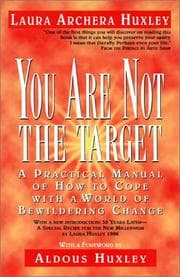
Cover of You are not the target

You are not the target

Laura Archera Huxley

1963

In this charming book, Laura Archera Huxley offers practical wisdom on how a human being in a chaotic world can cope with stress, anxiety, competition, & the uncertainty of the times. When we change,Ó she writes, others change too, & circumstances change in a manner that is almost miraculous,Ó & she points out that making others feel better generally makes us feel better.Ó Laura Huxley shows you how to change, how to influence the elements around you, how to cope successfully with the problems of the inner & outer world. To achieve this, she offers more than 33 Recipes for Living & Loving. A pioneering book of psychological good sense. Deceptively simple.Ó

Cover of Your perfect right

Your perfect right

Robert E. Alberti, Michael L. Emmons

1974

Guidance and support for people who lack confidence, have trouble maintaining relationships, or need to learn to defend themselves is provided in this time-tested guide to building self-esteem, protecting oneself from bullying or abuse, and making constructive use of anger. Realistic exercises are designed to be practiced in daily life, applied to struggles both small and large, and notably strengthen self-confidence and assertiveness. Una ayuda enorme para gente que se siente insegura, tiene dificultad en mantener relaciones positivas o necesita aprender como defenderse, este libro demuestra como adquirir seguridad en sí mismo, proteger sus derechos, enfrentar y controlar el enojo y relacionarse con personas "difíciles." Los procedimientos descritos son realistas, prácticos y han probado su eficacia.

Cover of The Right Words at the Right Time, Vol. 2

The Right Words at the Right Time, Vol. 2

Marlo Thomas, Jon B. Fish, Bruce Kluger, Carl Robbins, David Tabatsky

2006

From big cities to farm communities, from office cubicles to hospital wards, from Normandy Beach to Boston's Fenway Park, the contributors to this remarkable volume -- selected from among thousands in a nationwide search -- tell riveting stories about the words that changed their lives forever. You'll meet a "Plain Jane" from Seattle, whose world was rocked by a passing remark made by her favorite musician, backstage at a concert. You'll hear from the bereaved fiancé of a 9/11 victim, who found hope in a note pinned to a teddy bear. You'll laugh with a beleaguered soccer mom, who reveals the single phrase she never wants to hear again. And your heart will break for a prison inmate, who recalls the one piece of advice he still wishes he took. In each case, words had made all the difference. Marlo Thomas has once again tapped into the human spirit, assembling a breathtaking collection of beautiful and inspiring essays about the enduring power of words, and how their impact can last a lifetime. As a follow-up to her 2002 New York Times #1 bestseller, The Right Words at the Right Time, Thomas presents 101 new first-person stories that are at once universal and strikingly personal. Like the tale of a Gulf War veteran, whose life was transformed by just two words spoken by a young stranger at a Burger King. Or the aimless garage mechanic, who found salvation in a Help Wanted ad. Or the unsuspecting mother of three, who made a heart-warming discovery about her grandmother's "racy past." As this astonishing anthology proves, the "right words" can come from anywhere -- the pages of a dusty old songbook, the pulpit of a neighborhood church, the wreckage of Ground Zero, a hand-stitched sampler hanging on a wall, and a child's simple expression of love. The Right Words at the Right Time, Volume 2: Your Turn! is a collection to be read and read again -- a volume that will be cherished both by fans of the original book and anyone who has ever been touched by the startling and lif

Cover of Das Drama des begabten Kindes und die Suche nach dem wahren Selbst

Das Drama des begabten Kindes und die Suche nach dem wahren Selbst

Alice Miller

1979

The “drama” of the gifted—i.e., sensitive, alert—child consists of his recognition at a very early age of his parents' needs and of his adaptation to those needs. In the process, he learns to repress rather than to acknowledge his own intense feelings because they are unacceptable to his parents. Although it will not always be possible to avoid these “ugly” feelings (anger, indignation, despair, jealousy, fear) in the future, they will split off, and the most vital part of the “true self” (a key phrase in Alice Miller's works) will not be integrated into the personality. This leads to emotional insecurity and loss of self, which are revealed in depression or concealed behind a facade of grandiosity.Alice Miller defines the ideal state of genuine vitality, of free access to the true self and to authentic individual feelings that have their roots in childhood, as “healthy narcissism.” Narcissistic disturbances, on the other hand, represent for her solitary confinement of the true self within the prison of the false self. This is regarded less as an illness than as a tragedy.The examples Alice Miller presents make us aware of the child's unarticulated suffering and of the tragedy of parents who are unavailable to their children—the same parents who, when they were children, were available to fill their parents' needs. In her psychoanalytical work, Dr. Miller found that her patients' ability to experience authentic feelings, especially feelings of sadness, had been for the most part destroyed; it was her task to help her patients try to regain that long-lost capacity for genuine feelings that is the source of natural vitality. Many people who have read her books have discovered within themselves for the first time in their lives the little child they once were. This may explain the unusually strong and deep reactions Alice Miller's books have evoked in so many readers from different countries. The Drama of the Gifted Child and the Search for the True Self is the origina

Cover of Adult children of emotionally immature parents

Adult children of emotionally immature parents

Lindsay C. Gibson, Marguerite Gavin, Gavin Marguerite

2015

What happens when children are more mature than their parents? Growing up with an emotionally unavailable, immature, or selfish parent is painful, but rarely discussed. In this breakthrough book, clinical psychologist Lindsay C. Gibson exposes an often overlooked, yet extremely common syndrome that shapes the lives of so many people. Gibson also provides powerful skills to help the adult children of self-centered parents gain the insight they need to move on from feelings of loneliness and abandonment, and find healthy ways to meet their own emotional needs.

Frequently Asked Questions

What should I read after How to live 365 days a year?
Browse the similar books below — they're matched by subject overlap, author style, and reader preferences.
What books are most similar to How to live 365 days a year?
Our recommendations prioritize shared themes like Health, Longevity, Mental health and books enjoyed by similar readers.
Which similar book is best for beginners?
Check page counts and summaries on each recommendation. Shorter titles with broader appeal are usually the best starting point.

Promote Your Book on BestsellerFinder

Reach thousands of readers with featured placements, homepage spots, and newsletter features.

Get bestseller picks in your inbox

Weekly curated book recommendations. Unsubscribe anytime.

Explore More

Affiliate Disclosure: As an Amazon Associate, we may earn from qualifying purchases. Book links on this page may be affiliate links. This does not affect our recommendations or the price you pay.