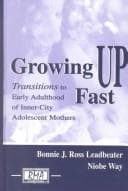
Cover of Growing up fast

Growing up fast

by Bonnie J. Ross Leadbeater, Niobe Way

Published 2001

The first edition of Growing Up Fast attempted to counter the stereotype of poor, minority adolescent mothers and describe the diversity of their educational, work, parenting, and relationship experiences. The volume followed a strengths-based approach to understanding why some mothers appeared resilient to the stresses of early parenting, compared to their peers, and what obstacles undermine resiliency for some of these young women. We hear their stories in their own words. We also see how many disadvantaged mothers go on to succeed in school, work, and parenting while avoiding many of the risk associated with teen parenting . The research is based on a six-year study of 120 young disadvantaged mothers and their children from New York City. It uniquely combines the analysis of longitudinal questionnaire data with qualitative analysis of extensive interviews conducted with these women focusing on the first six years after their child was born. A past winner of the Society for Research on Adolescence best book award, Growing Up Fast is a fascinating study of human resilience that will continue to be recognized for its contribution to individuals involved in program development and policymaking with teenage parenting. A new introductory chapter to the book suggests that we can look at the previous findings through a new lens that emphasizes not only the diversity of outcomes for young mothers and the sources of their strengths, but also asks what we can learn from these women about supporting their educational and work goals, as they transition to adulthood. New attention to emerging adulthood shows that this is a critical stage of life when the foundations for health and healthy life styles are laid down. Developmental tasks of this phase include building the capacity for financial and residential independence through post-secondary education and job training, and establishing stable sources of support from parents, romantic partners, and peers for all youth. Leadbea

Teenage mothersAdolescent girlsMothersYouth, united statesAdolescent psychologyAdolescent parentsWomen, united statesNew york (n.y.), social conditionsMères adolescentesFAMILY & RELATIONSHIPSParentingMotherhood

Similar Books

Cover of Building resilience in children and teens

Building resilience in children and teens

Kenneth R. Ginsburg, Martha M. Jablow

Confronting the overwhelming amount of stress kids face today, this invaluable guide offers coping strategies for facing the combined elements of academic performance, high achievement standards, media messages, peer pressure, and family tension. The handbook acknowledges that adolescents commonly survive stress by either indulging in unhealthy behaviors or giving up completely, and its suggested solutions are aimed at strengthening resilience. The proposed plan enables kids from the age of 18 months to 18 years to build the seven crucial "C's"--Competence, confidence, connection, character, co.

Cover of The five love languages of teenagers

The five love languages of teenagers

Gary D. Chapman

Socially, mentally, and spiritually teenagers face a variety of pressures and stresses each day. Despite these peer pressures; it is still parents who can influence teens the most. Are you equipped to love your teenager effectively? Get equipped to be a better parent as The Five Love Languages of Teenagers explores the world in which teenagers live; explains the developmental changes; and give tools to help you identify and appropriately communicate in your teens love language. Get practical tips on loving your teen effectively and explore key issues in your teen’s life including anger and independence. Finally learn how to set boundaries that are enforced with discipline and consequences, and discover useful ways for the difficult task of loving when your teen fails. Get ready to discover how the principles of the five love languages can really work in the lives of your teens and family. Over 400,000 copies sold!

Cover of Handbook of Parenting

Handbook of Parenting

Marc H. Bornstein

This highly anticipated third edition of the Handbook of Parentingbrings together an array of field-leading experts who have worked in different ways toward understanding the many diverse aspects of parenting. Contributors to the Handbooklook to the most recent research and thinking to shed light on topics every parent, professional, and policymaker wonders about. Parenting is a perennially "hot" topic. After all, everyone who has ever lived has been parented, and the vast majority of people become parents themselves. No wonder bookstores house shelves of "how-to" parenting books and magazine racks in pharmacies and airports overflow with periodicals that feature parenting advice. However, almost none of these is evidence-based. The Handbook of Parentingis. Period. Each chapter has been written to be read and absorbed in a single sitting, and includes historical considerations of the topic, a discussion of central issues and theory, a review of classical and modern research, and forecasts of future directions of theory and research. Together, the five volumes in the Handbookcover Children and Parenting, the Biology and Ecology of Parenting, Being and Becoming a Parent, Social Conditions and Applied Parenting, and the Practice of Parenting. Volume 1, Children and Parenting,considers parenthood as a functional status in the life cycle: Parents protect, nurture, and teach their progeny, even if human development is more dynamic than can be determined by parental caregiving alone. Volume 1 of the Handbook of Parentingbegins with chapters concerned with how children influence parenting. Notable are their more obvious characteristics, like child age or developmental stage; but subtler ones, like child gender, physical state, temperament, mental ability, and other individual-differences factors, are also instrumental. The chapters in Part I, on Parenting across the Lifespan, discuss the unique rewards and special demands of parenting children of different ages and stages -

Cover of Secrets of the Baby Whisperer

Secrets of the Baby Whisperer

Tracy Hogg, Melinda Blau

A unique program for understanding and communicating effectively with your baby from infant expert Tracy Hogg. The combination of interactive self-questioning and expert, friendly advice will change how you approach parenting, leading to transformative results. 'Miracles are her business' -- Jodie Foster 'The honest truth is that Tracy Hogg has provided me with more insight into the things that matter than anyone else' -- Observer Review 'She achieves what, to hard-pressed parents, seem like miracles' -- Mail on Sunday '...in a different league than all other 'how to manage as a parent' books' -- Daily Mail 'A book that changed our lives' -- ***** Reader review 'This book is amazing' -- ***** Reader review 'Great book, full of easy tips and tricks for new parents. I would highly recommend it!!!!' -- ***** Reader review 'The BEST baby advice book, EVER!!' -- ***** Reader review 'A God Send!' -- ***** Reader review **************************************************************** Tracy Hogg knows babies. She can calm even the most distressed or difficult infant, because she understands their language. Hence, her clients call her 'The Baby Whisperer'. In this remarkable parenting book, Tracy demystifies the magic she has performed with some five thousand babies. She teaches parents how to work out what kind of baby they have, what kind of mother or father they are, and what kind of parenting plan will work best for them. Believing that babies need to become part of the family - rather than dominate it - she has developed a practical programme that works with infants as young as a day old. Full of questionnaires, clearly explained theories and easy-to-follow, practical, expert advice - this book is guaranteed to set you on the path to calm and confident parenting.

Cover of Smart Woman's Guide to PMS and Pain-Free Periods

Smart Woman's Guide to PMS and Pain-Free Periods

Linda Woolven

An unabashed guide to symptom-free, drug-free periods For the 30 to 40 percent of women afflicted with PMS, traditional medicine can offer no genuine cures, only hormones, anti-depressants, and temporary pain-killers. Offering a practical, easy-to-implement plan for recovery from even the most debilitating forms of PMS, herbalist Linda Woolven outlines a natural powerhouse regimen of herbs, vitamins, minerals, and nutritional changes. A comprehensive guide to every aspect of women's menstrual and sexual health, the book also addresses menopause and osteoporosis. Combining scientific research and clinical experience with clear practical guidelines, this is an essential how-to health book for women of all ages. Linda Woolven (Toronto, ON, Canada) is the author of The Vegetarian Passport Cookbook (978-1-555041-331-1) and Healthy Herbs (978-1-555041-329-8).

Cover of Ikigai: The Japanese Secret to a Long and Happy Life

Ikigai: The Japanese Secret to a Long and Happy Life

Héctor García (Author), Francesc Miralles (Author) Format: Hardcover

INTERNATIONAL BESTSELLER • 2 MILLION+ COPIES SOLD WORLDWIDE “Workers looking for more fulfilling positions should start by identifying their ikigai.” ―Business Insider “One of the unintended—yet positive—consequences of the [pandemic] is that it is forcing people to reevaluate their jobs, careers, and lives. Use this time wisely, find your personal ikigai, and live your best life.” ―Forbes Find your ikigai (pronounced ee-key-guy) to live longer and bring more meaning and joy to all your days. “Only staying active will make you want to live a hundred years.” —Japanese proverb According to the Japanese, everyone has an ikigai—a reason for living. And according to the residents of the Japanese village with the world’s longest-living people, finding it is the key to a happier and longer life. Having a strong sense of ikigai—where what you love, what you’re good at, what you can get paid for, and what the world needs all overlap—means that each day is infused with meaning. It’s the reason we get up in the morning. It’s also the reason many Japanese never really retire (in fact there’s no word in Japanese that means retire in the sense it does in English): They remain active and work at what they enjoy, because they’ve found a real purpose in life—the happiness of always being busy. In researching this book, the authors interviewed the residents of the Japanese village with the highest percentage of 100-year-olds—one of the world’s Blue Zones. Ikigai reveals the secrets to their longevity and happiness: how they eat, how they move, how they work, how they foster collaboration and community, and—their best-kept secret—how they find the ikigai that brings satisfaction to their lives. And it provides practical tools to help you discover your own ikigai. Because who doesn’t want to find happiness in every day? What’s your ikigai?

Explore More

Affiliate Disclosure: As an Amazon Associate, we may earn from qualifying purchases. Book links on this page may be affiliate links. This does not affect our recommendations or the price you pay.