Books Like “Psychosomatics in peri-menopause

If you enjoyed Psychosomatics in peri-menopause by A. A. Haspels, Heymann Musaph, you likely appreciate Psychosomatic aspects, Complications, Menopause. These similar reads match the tone, themes, and audience of the original.

Not sure what to read next? Ask BestsellerFinder AI →

Psychosomatic aspectsComplicationsMenopausePsychophysiologic disordersPsychological aspects

Closest matches

Titles with overlapping themes, tone, and audience with your pick.

Cover of Psychology & Human Reproduction

Psychology & Human Reproduction

James W. Selby

1980

Providing information on the often-avoided subject of the psychological, psychiatric, and social aspects of reproduction, this book provides information on the psychosocial aspects of numerous major events in human reproduction. Psychology and Human Reproduction gives readers a comprehensive look at the events of human reproduction from a psychosocial understanding. Researchers provide unique insight on the common issues of major reproductive events that most people encounter, as well as in-depth information focusing on particular events of reproduction, such as pregnancy, delivery, and the postpartum period. Written by a team of highly qualified and educated professionals within the psychological and reproductive fields, this book attempts to provide reviews and critical analysis of the empirical findings that make up today’s human reproduction literature.

Cover of Journey Through Menopause

Journey Through Menopause

Christine Downing

1987

This intensely personal account of the little written-about sacred dimension of menopause combines religious studies with psychology to understand menopause as soul-event . regarding its symptoms as symbols and provides insight into what this transition can be like for those women who choose to embrace it as a meaningful part of their lives. Downing explores menopause as a rite of passage and reveals her own inner and outer journey through this process, using a trip she took to India when she turned 50 to mark the occasion. She shares with her sisters the lessons learned on the journey: the discovery that I was done with the heroic quest, the acceptance of weakness and vulnerability, the recognition of my dependence on other women, the revelation that I am loved enough.

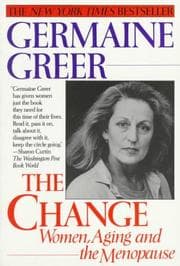
Cover of The Change

The Change

Germaine Greer

1991

In this study of the real and fundamental change which women experience during the menopause and which, like other fundamental changes, needs mental preparation and acceptance if it is not to be found unbearable, Dr Greer examines medical theories and treatment over the ages, and finds them often contradictory, excessive and, at times, dangerous. She responds to the traditional attitude of men and society which has been responsible for the creation of an image of the older woman as fake damsel or old crone. Dr Greer has weighed up the facts, the theories and the outright fabrications.

Cover of The Management of the Menopause & Post-Menopausal Years

The Management of the Menopause & Post-Menopausal Years

S. Campbell

1976

Despite the fact that the average woman spends one third of her life after the menopause, medical research has been devoted almost entirely to the repro ductive period of her life span. This is perhaps not surprising in our youth orientated society and yet there is increasing evidence that properly applied and supervised hormonal therapy could alleviate many of the severe physical symptoms which are associated with the ovarian menopause and that in the long term other aspects of physical deterioration could be modified. This lack of scientific research has made it difficult to assess which symptoms are due to the altered hormonal status of the post-menopausal period and which are due to the normal process of ageing, or the various psychological pressures which build up around most women in the fourth and fifth decades of life. In America doctors have been treating the 'menopausal syndrome' with estrogens for over 30 years, but in the United Kingdom gynaecologists and family doctors have been reticent to prescribe these steroid preparations. As a consequence, they have been labelled reactionary by the media and while there may be some truth -in this, it should be remembered that the hazar. ds associated with synthetic estrogens in the contraceptive pill were first brought to light by British epidemiological surveys.

Cover of Women's health in menopause

Women's health in menopause

P. G. Crosignani

1994

Few topics in women's medicine today are as fraught with confusion and controversy as the question of appropriate treatment for menopausal symptoms and the prevention of negative long term health outcomes common to post-menopausal women. Cardiovascular disease (CVD), osteoporosis, and cancer -- the most common causes of death, disability and impaired quality of life for women -- can potentially be prevented or forestalled by dietary, behavioral, and drug interventions. A better understanding of the natural history of the menopause is critical to providing better care. If women and their physicians have a better understanding of predictors of risk, they could make more informed decisions about interventions related to menopausal symptoms, CVD, osteoporosis and gynecologic and breast cancer. Few other recently introduced medical interventions have as great a potential of affecting morbidity and mortality as does hormone replacement therapy (HRT). HRT has produced effect on health risk: some are reduced, some are raised, and some uncertain, and these data are interpreted differently by various scientific, medical and consumer groups.

Readers also enjoyed

Popular and highly rated books from our library you might like next.
Cover of The Gift of Fear

The Gift of Fear

Gavin de Becker

1997

A carjacker lurking in a shopping mall parking lot. An abusive husband pounding on the door. A disgruntled employee brandishing a gun. These days, no one is safe from the specter of violence. But according to Gavin de Becker, everyone can feel safer, act safer, be safer -- if they learn how to listen to their own sixth sense about danger. De Becker has made a career of protecting people and predicting violent behavior. His firm handles security for many of Hollywood's top celebrities -- Madonna, Michael J. Fox, Geena Davis, Brooke Shields, and John Travolta, among others, according to press reports -- and his computerized risk-assessment system helps analyze threats to members of Congress and the Supreme Court. Now, in this unprecedented guide, de Becker shares his expertise with everyone. Covering all the dangerous situations people typically face -- street crime, domestic abuse, violence in the workplace -- de Becker provides real-life examples and offers specific advice on restraining orders, self-defense, and more. But the key to self-protection, he demonstrates, is learning how to trust -- and act on -- our own intuitions. For everyone who's ever felt threatened, this book is essential reading.

Cover of The five love languages of children

The five love languages of children

Gary D. Chapman, Ross Campbell

1997

Does your child speak a different language? Sometimes they wager for your attention, and other times they ignore you completely. Sometimes they are filled with gratitude and affection, and other times they seem totally indifferent. Attitude. Behavior. Development. Everything depends on the love relationship between you and your child. When children feel loved, they do their best. But how can you make sure your child feels loved? Since 1992, Dr. Gary Chapman's best-selling book The Five Love Languages has helped more than 300,000 couples develop stronger, more fulfilling relationships by teaching them to speak each others love language. Each child, too, expresses and receives love through one of five different communication styles. And your love language may be totally different from that of your child. While you are doing all you can to show your child love, he may be hearing it as something completely opposite.Discover your child's primary language and learn what you can do to effectively convey unconditional feelings of respect, affection, and commitment that will resonate in your child's emotions and behavior.

Cover of Mothering and Ambivalence

Mothering and Ambivalence

Brid Featherstone

1997

Brid Featherstone's "Mothering and Ambivalence" delves into the complex emotional landscape of motherhood, exploring the inherent contradictions and conflicting feelings that many mothers experience. Drawing on psychoanalytic theory, Featherstone illuminates how societal pressures and individual experiences shape these ambivalent emotions, offering a nuanced understanding of the mother-child bond. The book provides a framework for recognizing and navigating the often-unacknowledged ambivalence that is a fundamental aspect of mothering.

Cover of Posttraumatic growth

Posttraumatic growth

Richard G. Tedeschi, Lawrence G. Calhoun

1998

The new edition of Posttraumatic Growth: Theory, Research, and Applications includes the latest developments in the science of posttraumatic growth, including responses to the COVID-19 pandemic, epigenetics, and new interventions to facilitate growth after trauma. The book provides a wide range of answers to questions about the theory behind posttraumatic growth (PTG), its synthesis and contrast with other theories and models, and its applications in diverse settings. Posttraumatic Growth starts with an overview of the history, components, and outcomes of PTG. Next, chapters review quantitative, qualitative, and cross-cultural research on PTG, including in relation to cognitive function, identity formation, cross-national and gender differences, and similarities and differences between adults and children. The final section shows readers how to facilitate optimal outcomes with PTG at the level of the individual, the group, the community, and society.

Cover of Health psychology

Health psychology

David F. Marks, Michael Murray, Brian Evans, Carla Willig

1999

Health Psychology students will need to understand how to evaluate and critically-appraise the latest theory and research before it can be applied. This fully-revised and updated fourth edition takes a critical approach and places Health Psychology in a real-world context, enabling students to understand how public policy, theory and research can influence communities and individuals alike. The new edition includes: A new chapter on diet and obesity Updated material on stress and coping, doctor-patient communication, death, dying, bereavement and quality of life Introductions to the social, political and economic conditions that influence our health Breadth of coverage from social inequality through to chronic illness and screening An enhanced SAGE edge™ companion website (edge.sagepub.com/marks4e) with a suite of features to enhance students' learning experience.

Cover of Scattered

Scattered

Gabor Maté

1999

Gabor Maté's *Scattered* explores Attention-Deficit Hyperactivity Disorder (ADHD) not as a simple neurological deficit, but as a complex response to environmental and psychological stressors, often rooted in early life experiences. Maté argues that societal pressures and emotional burdens contribute significantly to the development and manifestation of ADHD symptoms, reframing it as a survival mechanism in challenging circumstances. The book delves into the profound impact of early experiences and the environment on brain development, offering a compassionate and insightful perspective on understanding and managing ADHD.

Cover of I wasn't ready to say goodbye

I wasn't ready to say goodbye

Brook Noel, Pamela Blair

2000

Updated and Revised, this best-selling book authored by two women who have lost someone firsthand is a timeless and sensitive resource to help those who have lost someone tragically deal with the grieving process. This expanded edition will include an expanded section on "What is next?" and dealing with survivors guilt and grief after events such as 9/11 and Katrina. This revised edition will also add more on compounded grief or mulitple losses. Authors Noel and Blair address the question of are we ever really ready to say goodbye? First Edition has sold over 80,000 copies.

Cover of The New Don't Blame Mother

The New Don't Blame Mother

Paula Caplan

2000

In 1990, Paula Caplan, a nationally recognized expert on the psychology of women, wrote the groundbreaking Don'tBlame Mother. Now, almost ten years later, she finds that we are still blaming mothers. Fully revised, updated with a new introduction, this second edition proposes new ways of mending the mother-daughter relationship. The NewDon't Blame Mother: Mending the Mother-DaughterRelationship shows us that dangerous myths about mothers pervade our culture and have created or aggravated many of the problems between mothers and daughters. Myths of the Perfect Mother give rise to impossible expectations and set mothers up for failure--good mothers don't get angry, good mothers are endlessly giving--and myths of the Bad Mother exaggerate mothers' failings and create a monster figure in her image--mothers are too needy, mothers can't let go. Caplan shows that if women can identify these myths then they can take concrete steps to build a strong and loving relationship with their mothers. The New Don't Blame Mother shows how the anger and agony of the mother-daughter relationship can be replaced with a new bond based on understanding and respect. The New Don't Blame Mother is a must-read for all mothers and daughters. Caplan, drawing on over twenty-five years of research, clinical practice, and the experience of workshop participants, will show you how to stop blaming mother and, instead, start loving her.

Cover of Working with substance misusers

Working with substance misusers

Trudi Petersen, Andrew McBride

2002

Working with Substance Misusers is a practical handbook for students and those who work with people who misuse drugs or alcohol. Written by experienced teachers and clinicians, the book introduces: * the substances themselves * theories relevant to substance use and misuse * the skills necessary to work with this client group * the broad range of approaches to treatment * particular problems of specific groups. The reader is encouraged to read and reflect on the material in relation to their own practice. To help this process, each topic has an identified set of learning objectives. Activities designed to reinforce learning include discussion points, case studies, role plays and group exercises. Working with Substance Misusers makes clear the connection of theory to practice and encourages a skills-based, but reflective, approach to work in this complex field. Cutting across professional boundaries, it provides both new and more experienced practitioners with a key text.

Frequently Asked Questions

What should I read after Psychosomatics in peri-menopause?
Browse the similar books below — they're matched by subject overlap, author style, and reader preferences.
What books are most similar to Psychosomatics in peri-menopause?
Our recommendations prioritize shared themes like Psychosomatic aspects, Complications, Menopause and books enjoyed by similar readers.
Which similar book is best for beginners?
Check page counts and summaries on each recommendation. Shorter titles with broader appeal are usually the best starting point.

Promote Your Book on BestsellerFinder

Reach thousands of readers with featured placements, homepage spots, and newsletter features.

Get bestseller picks in your inbox

Weekly curated book recommendations. Unsubscribe anytime.

Explore More

Affiliate Disclosure: As an Amazon Associate, we may earn from qualifying purchases. Book links on this page may be affiliate links. This does not affect our recommendations or the price you pay.