
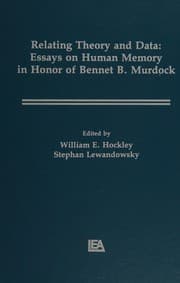
Relating theory and data
Kam Knight
First Published in 1991. Routledge is an imprint of Taylor & Francis, an informa company.
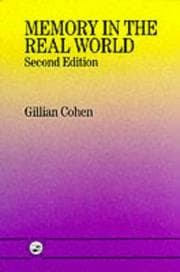
Published 1989
Check availability on Amazon
Are you the author or publisher of this book?
Claim this book — FreeUpdate metadata for “Memory in the real world” after verification.
BestsellerFinder Score unavailable — not enough catalog data yet.
This textbook has been updated and extended to include recent research in all areas of everyday memory.
Kam Knight
First Published in 1991. Routledge is an imprint of Taylor & Francis, an informa company.
American Psychological Association
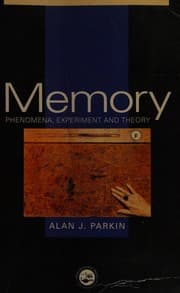
Sections in subsequent chapters deal with memory loss; how memory is measured and how to interpret reports; legalistic aspects of memory; the nature and reliability of memory in children; changes in memory across the life-span; dementia; hypnosis; false memory; and memory therapy.".
Chizuko Izawa
Chizuko Izawa's "On Human Memory" offers a comprehensive exploration of memory's intricate mechanisms, delving into theoretical models that explain how information is encoded, stored, and retrieved. The book bridges cognitive psychology with mathematical frameworks, presenting formalisms that offer insights into memory's capacity and limitations. While grounded in scientific theory, it also provides practical implications for understanding personal growth and potential avenues for memory improvement.
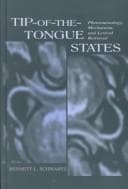
Bennett L. Schwartz
Tip-of-the-Tongue experiences are one of those illusive oddities of human cognition. Like slips of the tongue, déjà vu, and visual illusions, TOTs dazzle us with their subjective strength, yet, at the same time, puzzle us with our frustrating inability to retrieve the desired word. This book discusses what little is known about TOTs and speculates about much of the rest of the riddle. Cognitive psychologists know a lot about processes but generally avoid issues of conscious experience and phenomenology. Because the larger goal of this book is to relate the TOT experience to the study of human phenomenology, it goes beyond the conventional cognitive psychology question, "What causes tip-of-the-tongue experiences?" to ask, "Why do we experience TOTs at all?"
Cole Peterson
A clear look at what you are actually giving up when you keep trading the present for a fiction called later.

Cole Peterson
About showing up, slowing down, and loving your kids in the time you still have.
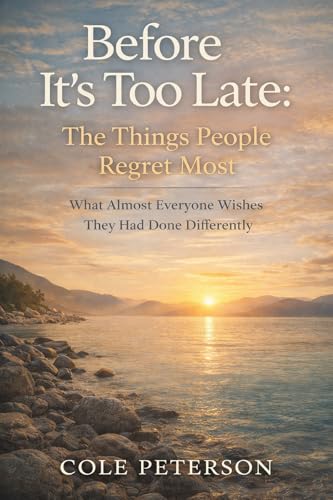
Cole Peterson
See what shows up in real lives before the door closes. Straight talk, not a lecture.

Vishal Shah
Helping you think about staying active, connected, and healthy when the old structure is gone.

Stanton Samenow
Short, sobering, clarifying, from people who have already lived the parts of life you are still racing through.
Affiliate Disclosure: As an Amazon Associate, we may earn from qualifying purchases. Book links on this page may be affiliate links. This does not affect our recommendations or the price you pay.