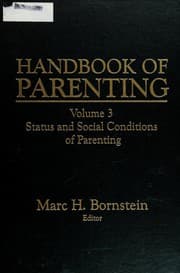

Cover of Handbook of Parenting

Handbook of Parenting

by Marc H. Bornstein

Published 1995

This highly anticipated third edition of the Handbook of Parentingbrings together an array of field-leading experts who have worked in different ways toward understanding the many diverse aspects of parenting. Contributors to the Handbooklook to the most recent research and thinking to shed light on topics every parent, professional, and policymaker wonders about. Parenting is a perennially "hot" topic. After all, everyone who has ever lived has been parented, and the vast majority of people become parents themselves. No wonder bookstores house shelves of "how-to" parenting books and magazine racks in pharmacies and airports overflow with periodicals that feature parenting advice. However, almost none of these is evidence-based. The Handbook of Parentingis. Period. Each chapter has been written to be read and absorbed in a single sitting, and includes historical considerations of the topic, a discussion of central issues and theory, a review of classical and modern research, and forecasts of future directions of theory and research. Together, the five volumes in the Handbookcover Children and Parenting, the Biology and Ecology of Parenting, Being and Becoming a Parent, Social Conditions and Applied Parenting, and the Practice of Parenting. Volume 1, Children and Parenting,considers parenthood as a functional status in the life cycle: Parents protect, nurture, and teach their progeny, even if human development is more dynamic than can be determined by parental caregiving alone. Volume 1 of the Handbook of Parentingbegins with chapters concerned with how children influence parenting. Notable are their more obvious characteristics, like child age or developmental stage; but subtler ones, like child gender, physical state, temperament, mental ability, and other individual-differences factors, are also instrumental. The chapters in Part I, on Parenting across the Lifespan, discuss the unique rewards and special demands of parenting children of different ages and stages -

Child care & upbringingFamily & relationshipsPsychologySocial ScienceChild Development And RearingParent And ChildFamily / Parenting / ChildbirthSociologyParenting - GeneralSociology - Marriage & FamilyParentingParents

Similar Books

Cover of The Yellow Wallpaper

The Yellow Wallpaper

Charlotte Perkins Gilman, Aric Cushing, Logan Thomas, SparkNotes, Bryan Hunt, A. J. Alexander, Steven Stern, Aileen Oracion, Twisted Classics, Anne Geer, Sara Barkat, Period Time Publishing, Félix Gerónimo, Agustín López Tobajas, Nicolae Sfetcu, Erminia Passannanti

En 1885, un año después de haberse casado con Charles Walter Stetson, Charlotte Perkins Gilman dio a luz a su hija, Katharine, y al poco tiempo entró en una profunda depresión. El doctor Silas Weir Mitchell, un reputado neurólogo a quien había acudido en busca de ayuda, le diagnosticó agotamiento de los nervios y le prescribió una cura de descanso, un controvertido tratamiento en el que era pionero. «Vive una vida tan hogareña como te sea posible, realiza no más de dos horas de actividad intelectual al día y no toques nunca más una pluma, un pincel o un lapicero»: estas fueron las instrucciones que le dio el médico a la autora. Durante unos meses siguió estos consejos, pero su depresión se agravó, y, según sus propias palabras, se acercó tanto a la frontera de la profunda ruina mental que llegó a vislumbrar el otro lado. Solo haciendo caso omiso de los consejos del médico y volviendo al trabajo logró recuperarse de su depresión. Esta experiencia la marcó hasta tal punto que en 1890 escribió "El papel pintado amarillo", un estremecedor relato que constituye una demoledora crítica al tratamiento prescrito por el doctor Mitchell.

Affiliate Disclosure: As an Amazon Associate, we may earn from qualifying purchases. Book links on this page may be affiliate links. This does not affect our recommendations or the price you pay.