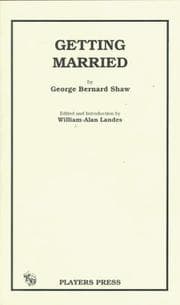
Cover of Getting married

Getting married

by George Bernard Shaw

Published 1911

This work has been selected by scholars as being culturally important and is part of the knowledge base of civilization as we know it. This work is in the public domain in the United States of America, and possibly other nations. Within the United States, you may freely copy and distribute this work, as no entity (individual or corporate) has a copyright on the body of the work. Scholars believe, and we concur, that this work is important enough to be preserved, reproduced, and made generally available to the public. To ensure a quality reading experience, this work has been proofread and republished using a format that seamlessly blends the original graphical elements with text in an easy-to-read typeface. We appreciate your support of the preservation process, and thank you for being an important part of keeping this knowledge alive and relevant.

DramaMarried peopleMarriageWeddings

Similar Books

Cover of The Age of Innocence

The Age of Innocence

Edith Wharton

Edith Wharton’s acclaimed novel of love, duty, and half-known truths in Gilded Age New York society, with a foreword by bestselling author Elif Batuman Dutiful Newland Archer, an eligible young man from New York high society, is about to announce his engagement to May Welland, a suitable match from a good family, when May’s cousin, the beautiful and exotic Countess Ellen Olenska, is introduced into their circle. The Countess brings with her an aura of European sophistication and a hint of perceived scandal, having left her husband and claimed her independence. Her worldliness, disregard for society’s rules, and air of unapproachability attract the sensitive Newland, despite his enthusiasm about a marriage to May and the societal advantages it would bring. Almost against their will, Newland and Ellen develop a passionate bond, and a classic love triangle takes shape as the three young people find themselves drawn into a poignant and bitter conflict between love and duty. Written in 1920, Edith Wharton’s Pulitzer Prize-winning novel about a time and place long gone by—1870s New York City—beautifully captures the complexities of passion, independence, and fulfillment, and how painfully hard it can be for individuals to truly see one another and their place in the world. For more than seventy years, Penguin has been the leading publisher of classic literature in the English-speaking world. With more than 1,700 titles, Penguin Classics represents a global bookshelf of the best works throughout history and across genres and disciplines. Readers trust the series to provide authoritative texts enhanced by introductions and notes by distinguished scholars and contemporary authors, as well as up-to-date translations by award-winning translators.

Cover of Ethan Frome

Ethan Frome

Edith Wharton

"Ethan Frome" by Edith Wharton is a poignant exploration of isolation, duty, and unfulfilled desires set against the bleak backdrop of a New England winter. The narrative unfolds through the eyes of an unnamed narrator who becomes intrigued by the enigmatic figure of Ethan Frome, a man marked by physical and emotional scars. The story is set in the fictional town of Starkfield, Massachusetts, where the harsh winter mirrors the desolation in Ethan's life. Ethan is trapped in a loveless marriage with his sickly wife, Zeena, and burdened by the responsibilities of his failing farm. The arrival of Mattie Silver, Zeena's young cousin, brings a glimmer of hope and warmth into Ethan's life. As Ethan and Mattie grow closer, their mutual affection becomes a source of both joy and torment, as they are bound by societal and moral constraints. The tension culminates in a tragic "smash-up," leaving Ethan physically and emotionally crippled. Wharton's narrative delves into themes of duty versus desire, the effect of environment on the human spirit, and the tragic consequences of choices constrained by circumstance. Through vivid descriptions and a keen psychological insight, Wharton paints a haunting portrait of a man caught between the life he yearns for and the one he is forced to endure.

Cover of The Longest Journey

The Longest Journey

E. M. Forster

Edward Morgan Forster (1 January 1879 - 7 June 1970) was an English novelist, short story writer, essayist and librettist. He is known best for his ironic and well-plotted novels examining class difference and hypocrisy in early 20th-century British society. Forster's humanistic impulse toward understanding and sympathy may be aptly summed up in the epigraph to his 1910 novel Howards End: "Only connect ... ". His 1908 novel, A Room with a View, is his most optimistic work, while A Passage to India (1924) brought him his greatest success. He was nominated for the Nobel Prize in Literature in 13 different years.

Cover of Misalliance

Misalliance

George Bernard Shaw

George Bernard Shaw was born in Dublin in 1856. Before becoming a playwright he wrote music and literary criticism. Shaw used his writing to attack social problems such as education, marriage, religion, government, health care, and class privilege. Shaw was particularly conscious of the exploitation of the working class Misalliance is a 1909 house-comedy. There is a clash between social classes when an Edwardian aristocrat wants to marry the daughter of an underwear tycoon. The entire play takes place in an afternoon in a Victorian drawing room.

Cover of The climacteric in perspective

The climacteric in perspective

International Congress on the Menopause (4th 1984 Lake Buena Vista, Fla.), M. Notelovitz, P.A. van Keep

The Fourth International Congress on the Menopause was held in Lake Buena Vista, Florida, USA in October - November 1984. It was different from the previous meetings held under the auspices of the International Menopause Society in three respects: the duration of the Congress was extended to five days, plenary sessions were held on each day, and the scope of the subject matter was expanded to provide a total or holistic overview of the subject - hence the theme for the Congress 'Climacteric Medicine and Science: A Societal need. ' In recent years there has been an increased interest in the menopause and middle year aging by scientists and clinicians in fields as diverse as anthropology, urodynamics, nutrition and exercise physiology, while 'newer' issues in clinical medicine, such as osteoporosis prevention and management, attracted specialists in nuclear immaging techniques and internal medicine. Over 120 invited speakers plus numerous contributors to the free communication, special lectures and the poster sessions provided a virtual cornucopia of information on the menopause, that has indeed brought a newer perspective to a subject previously the domain of a single specialty, the gynecologist, and dominated by a single therapy, estrogen replacement.

Cover of Great Expectations

Great Expectations

Charles Dickens

Great Expectations was first published as a weekly serial in All the Year Round, December 1860 - August 1861. Its first appearance in volume form was as three-volume novel, without illustrations, in July 1861. A one-volume edition, the next year, preceded its inclusion in the collected editions of Dickens's lifetime. The three-volume 1861 edition is the basis of the present text: variant readings, including those in manuscript and extant proofs, are recorded in the textual apparatus, providing an unusually rich source of information on Dickens's methods of composition. The Introduction traces this process of composition and draws attention to the two unperformed dramatic adaptations: the reading version and the 1861 play version, made as a safeguard of copyright. Appendices include the original ending, the author's notes, and two textual examinations, one of the five so-called `editions' of 1861, the other a comparison of the one-volume 1862 edition with the 1864 Library edition.

Cover of How not to hate your husband after kids

How not to hate your husband after kids

Jancee Dunn

'Clever, honest and hilarious . . . her book should become a baby shower classic.' Publishers Weekly 'Funny, honest and helpful.' Grazia 'Loads of useful, achievable advice.' The Pool How did I become the 'expert' at changing a nappy? Jancee Dunn wondered. This, combined with a lack of sleep, a suddenly unfair division of household chores and her husband's new found passion for very long bike rides, meant that Jancee found it hard to look at her well-meaning, clever, funny husband playing with his iPhone without feeling a white-hot rage. Like many expectant parents, they'd spent weeks researching the safest car seat but little time thinking about the titanic impact the baby would have on their marriage - and the way their marriage would affect their child. Tired of having the same fights over and over, Dunn consults the latest relationship research, solicits the counsel of renowned sex and couples therapists, canvasses friends and parents, and even consults an FBI hostage negotiator on how to effectively contain an 'explosive situation'. Could it be that the person who got her into this position is the ally she'd forgotten she had? Funny, honest and actually helpful, this book can't do the washing but it might just save your marriage.

Explore More

Affiliate Disclosure: As an Amazon Associate, we may earn from qualifying purchases. Book links on this page may be affiliate links. This does not affect our recommendations or the price you pay.