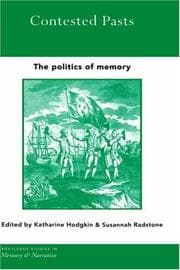
Cover of Contested pasts

Contested pasts

by Katharine Hodgkin, Susannah Radstone

Published 2003

The chapters in Memory, History, Nation, written by international scholars, offer a complex awareness of the workings of memory, and the ways in which different or changing histories may be explained. They explore the relation between individual and social memory, between real and imaginary, event and fantasy, history and myth. Contradictory accounts, or memories in direct contradiction to the historical record are not always the sign of a repressive authority attempting to cover something up. The tension between memory as a safeguard against attempts to silence dissenting voices, and memorys own implication in that silencing, runs throughout the book.

Social aspectsPolitical aspectsMemoryHistoryRecollection (Psychology)Mental RecallMémoireHistoireRappel (Psychologie)History (discipline)SELF-HELPPersonal Growth

Similar Books

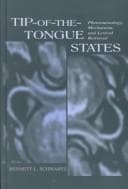
Cover of Tip-of-the-tongue States

Tip-of-the-tongue States

Bennett L. Schwartz

Tip-of-the-Tongue experiences are one of those illusive oddities of human cognition. Like slips of the tongue, déjà vu, and visual illusions, TOTs dazzle us with their subjective strength, yet, at the same time, puzzle us with our frustrating inability to retrieve the desired word. This book discusses what little is known about TOTs and speculates about much of the rest of the riddle. Cognitive psychologists know a lot about processes but generally avoid issues of conscious experience and phenomenology. Because the larger goal of this book is to relate the TOT experience to the study of human phenomenology, it goes beyond the conventional cognitive psychology question, "What causes tip-of-the-tongue experiences?" to ask, "Why do we experience TOTs at all?"
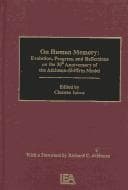
Cover of on Human Memory

on Human Memory

Chizuko Izawa

Chizuko Izawa's "On Human Memory" offers a comprehensive exploration of memory's intricate mechanisms, delving into theoretical models that explain how information is encoded, stored, and retrieved. The book bridges cognitive psychology with mathematical frameworks, presenting formalisms that offer insights into memory's capacity and limitations. While grounded in scientific theory, it also provides practical implications for understanding personal growth and potential avenues for memory improvement.

Cover of The Art of War

The Art of War

孙武 (Sun Tzu), Stephen F. Kaufman, Lionel Giles, Onésimo Colavidas

Sun Tzu's ancient treatise, "The Art of War," offers timeless strategic principles applicable beyond the battlefield to business, politics, and personal conflict. It emphasizes understanding oneself and the enemy, the importance of deception and adaptability, and the value of achieving victory with minimal confrontation. Through its concise aphorisms and insightful observations, the work provides a framework for decisive action and the cultivation of superior strategic thinking.

Cover of Pride and Prejudice

Pride and Prejudice

Jane Austen

Austen’s most celebrated novel tells the story of Elizabeth Bennet, a bright, lively young woman with four sisters, and a mother determined to marry them to wealthy men. At a party near the Bennets’ home in the English countryside, Elizabeth meets the wealthy, proud Fitzwilliam Darcy. Elizabeth initially finds Darcy haughty and intolerable, but circumstances continue to unite the pair. Mr. Darcy finds himself captivated by Elizabeth’s wit and candor, while her reservations about his character slowly vanish. The story is as much a social critique as it is a love story, and the prose crackles with Austen’s wry wit.

Cover of Great Expectations

Great Expectations

Charles Dickens

Great Expectations was first published as a weekly serial in All the Year Round, December 1860 - August 1861. Its first appearance in volume form was as three-volume novel, without illustrations, in July 1861. A one-volume edition, the next year, preceded its inclusion in the collected editions of Dickens's lifetime. The three-volume 1861 edition is the basis of the present text: variant readings, including those in manuscript and extant proofs, are recorded in the textual apparatus, providing an unusually rich source of information on Dickens's methods of composition. The Introduction traces this process of composition and draws attention to the two unperformed dramatic adaptations: the reading version and the 1861 play version, made as a safeguard of copyright. Appendices include the original ending, the author's notes, and two textual examinations, one of the five so-called `editions' of 1861, the other a comparison of the one-volume 1862 edition with the 1864 Library edition.

Explore More

Affiliate Disclosure: As an Amazon Associate, we may earn from qualifying purchases. Book links on this page may be affiliate links. This does not affect our recommendations or the price you pay.