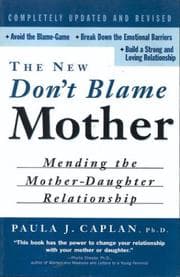
Cover of The New Don't Blame Mother

The New Don't Blame Mother

by Paula Caplan

Published 2000

In 1990, Paula Caplan, a nationally recognized expert on the psychology of women, wrote the groundbreaking Don'tBlame Mother. Now, almost ten years later, she finds that we are still blaming mothers. Fully revised, updated with a new introduction, this second edition proposes new ways of mending the mother-daughter relationship. The NewDon't Blame Mother: Mending the Mother-DaughterRelationship shows us that dangerous myths about mothers pervade our culture and have created or aggravated many of the problems between mothers and daughters. Myths of the Perfect Mother give rise to impossible expectations and set mothers up for failure--good mothers don't get angry, good mothers are endlessly giving--and myths of the Bad Mother exaggerate mothers' failings and create a monster figure in her image--mothers are too needy, mothers can't let go. Caplan shows that if women can identify these myths then they can take concrete steps to build a strong and loving relationship with their mothers. The New Don't Blame Mother shows how the anger and agony of the mother-daughter relationship can be replaced with a new bond based on understanding and respect. The New Don't Blame Mother is a must-read for all mothers and daughters. Caplan, drawing on over twenty-five years of research, clinical practice, and the experience of workshop participants, will show you how to stop blaming mother and, instead, start loving her.

MotherhoodPsychologyPsychological aspectsMothers and daughtersIntergenerational relationsWomenCommunication in familiesInterpersonal relationsSocial aspectsMères et fillesFemmesPsychologie

Similar Books

Cover of Handbook of Parenting

Handbook of Parenting

Marc H. Bornstein

This highly anticipated third edition of the Handbook of Parentingbrings together an array of field-leading experts who have worked in different ways toward understanding the many diverse aspects of parenting. Contributors to the Handbooklook to the most recent research and thinking to shed light on topics every parent, professional, and policymaker wonders about. Parenting is a perennially "hot" topic. After all, everyone who has ever lived has been parented, and the vast majority of people become parents themselves. No wonder bookstores house shelves of "how-to" parenting books and magazine racks in pharmacies and airports overflow with periodicals that feature parenting advice. However, almost none of these is evidence-based. The Handbook of Parentingis. Period. Each chapter has been written to be read and absorbed in a single sitting, and includes historical considerations of the topic, a discussion of central issues and theory, a review of classical and modern research, and forecasts of future directions of theory and research. Together, the five volumes in the Handbookcover Children and Parenting, the Biology and Ecology of Parenting, Being and Becoming a Parent, Social Conditions and Applied Parenting, and the Practice of Parenting. Volume 1, Children and Parenting,considers parenthood as a functional status in the life cycle: Parents protect, nurture, and teach their progeny, even if human development is more dynamic than can be determined by parental caregiving alone. Volume 1 of the Handbook of Parentingbegins with chapters concerned with how children influence parenting. Notable are their more obvious characteristics, like child age or developmental stage; but subtler ones, like child gender, physical state, temperament, mental ability, and other individual-differences factors, are also instrumental. The chapters in Part I, on Parenting across the Lifespan, discuss the unique rewards and special demands of parenting children of different ages and stages -

Cover of Growing up fast

Growing up fast

Bonnie J. Ross Leadbeater, Niobe Way

The first edition of Growing Up Fast attempted to counter the stereotype of poor, minority adolescent mothers and describe the diversity of their educational, work, parenting, and relationship experiences. The volume followed a strengths-based approach to understanding why some mothers appeared resilient to the stresses of early parenting, compared to their peers, and what obstacles undermine resiliency for some of these young women. We hear their stories in their own words. We also see how many disadvantaged mothers go on to succeed in school, work, and parenting while avoiding many of the risk associated with teen parenting . The research is based on a six-year study of 120 young disadvantaged mothers and their children from New York City. It uniquely combines the analysis of longitudinal questionnaire data with qualitative analysis of extensive interviews conducted with these women focusing on the first six years after their child was born. A past winner of the Society for Research on Adolescence best book award, Growing Up Fast is a fascinating study of human resilience that will continue to be recognized for its contribution to individuals involved in program development and policymaking with teenage parenting. A new introductory chapter to the book suggests that we can look at the previous findings through a new lens that emphasizes not only the diversity of outcomes for young mothers and the sources of their strengths, but also asks what we can learn from these women about supporting their educational and work goals, as they transition to adulthood. New attention to emerging adulthood shows that this is a critical stage of life when the foundations for health and healthy life styles are laid down. Developmental tasks of this phase include building the capacity for financial and residential independence through post-secondary education and job training, and establishing stable sources of support from parents, romantic partners, and peers for all youth. Leadbea
Cover of Emotionally intelligent parenting

Emotionally intelligent parenting

Maurice J. Elias, Steven E. Tobias, Brian S. Friedlander, Maurice J. Phd Elias, Steven E. Psyd Tobias, Brian S. Phd Friedlander, Maueice J. Elias, Brian S., Ph.D. Friedlander, Various

Daniel Goleman's bestseller Emotional Intelligence opened a new way of thinking about the skills necessary for meeting life's challenges. Expanding on the insights brought to light by the same research project, this book presents parents with many practical, realistic ways to help children develop the qualities of emotional intelligence: self-awareness, control of impulsive behaviour, co-operative work habits, care for themselves, and sympathy for others.

Cover of Grit

Grit

Angela Duckworth

In this must-read book for anyone striving to succeed, pioneering psychologist Angela Duckworth shows parents, educators, athletes, students, and business people—both seasoned and new—that the secret to outstanding achievement is not talent but a focused persistence called “grit.” Why do some people succeed and others fail? Sharing new insights from her landmark research on grit, MacArthur “genius” Angela Duckworth explains why talent is hardly a guarantor of success. Rather, other factors can be even more crucial such as identifying our passions and following through on our commitments. Drawing on her own powerful story as the daughter of a scientist who frequently bemoaned her lack of smarts, Duckworth describes her winding path through teaching, business consulting, and neuroscience, which led to the hypothesis that what really drives success is not “genius” but a special blend of passion and long-term perseverance. As a professor at the University of Pennsylvania, Duckworth created her own “character lab” and set out to test her theory. Here, she takes readers into the field to visit teachers working in some of the toughest schools, cadets struggling through their first days at West Point, and young finalists in the National Spelling Bee. She also mines fascinating insights from history and shows what can be gleaned from modern experiments in peak performance. Finally, she shares what she’s learned from interviewing dozens of high achievers—from JP Morgan CEO Jamie Dimon to the cartoon editor of The New Yorker to Seattle Seahawks Coach Pete Carroll. Winningly personal, insightful, and even life-changing, Grit is a book about what goes through your head when you fall down, and how that—not talent or luck—makes all the difference.

Cover of Smart Woman's Guide to PMS and Pain-Free Periods

Smart Woman's Guide to PMS and Pain-Free Periods

Linda Woolven

An unabashed guide to symptom-free, drug-free periods For the 30 to 40 percent of women afflicted with PMS, traditional medicine can offer no genuine cures, only hormones, anti-depressants, and temporary pain-killers. Offering a practical, easy-to-implement plan for recovery from even the most debilitating forms of PMS, herbalist Linda Woolven outlines a natural powerhouse regimen of herbs, vitamins, minerals, and nutritional changes. A comprehensive guide to every aspect of women's menstrual and sexual health, the book also addresses menopause and osteoporosis. Combining scientific research and clinical experience with clear practical guidelines, this is an essential how-to health book for women of all ages. Linda Woolven (Toronto, ON, Canada) is the author of The Vegetarian Passport Cookbook (978-1-555041-331-1) and Healthy Herbs (978-1-555041-329-8).

Explore More

Affiliate Disclosure: As an Amazon Associate, we may earn from qualifying purchases. Book links on this page may be affiliate links. This does not affect our recommendations or the price you pay.