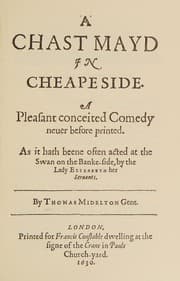
Cover of A chaste maide in Cheapside

A chaste maide in Cheapside

by Thomas Middleton

Published 1630

Written for the adult players at the open-air Swan theatre in 1613, this master-piece of Jacobean city comedy signals its ironic natureeven in the title: chaste maids, like most other goods and people inLondon's busiest commercial area, are likely to be fake. Money is moreimportant than either happiness or honour; and the most covetedcommodities to be bought with it are sex and social prestige. Middletoninterweaves the fortunes of four families, who either seek to marrytheir children off as profitably as possible, to stop having any morefor fear of poverty, or to acquire some in order to keep their propertyin the family. Most prosperous is the husband who pimps his wife to arich knight and lets him support the household with his alimony. Likemany early modern critics of London's enormous growth, this playwarned: the city is a monster that lives off the money the countryproduces.

British and irish drama (dramatic works by one author)American drama (dramatic works by one author)English dramaThéâtre anglaisMarriageDramaSocial conditionsHistoryPolitics and government

Similar Books

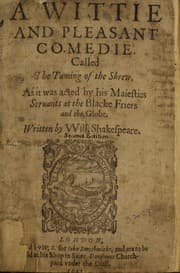
Cover of The Taming of the Shrew

The Taming of the Shrew

William Shakespeare

The Wonder of Shakespeare One who reads a few of Shakespeare's great plays and then the meager story of his life is generally filled with a vague wonder. Here is an unknown country boy, poor and poorly educated according to the standards of his age, who arrives at the great city of London and goes to work at odd jobs in a theater. In a year or two he is associated with scholars and dramatists, the masters of their age, writing plays of kings and clowns, of gentlemen and heroes and noble women, all of whose lives he seems to know by intimate association. In a few years more he leads all that brilliant group of poets and dramatists who have given undying glory to the Age of Elizabeth. Play after play runs from his pen, mighty dramas of human life and character following one another so rapidly that good work seems impossible; yet they stand the test of time, and their poetry is still unrivaled in any language. For all this great work the author apparently cares little, since he makes no attempt to collect or preserve his writings. A thousand scholars have ever since been busy collecting, identifying, classifying the works which this magnificent workman tossed aside so carelessly when he abandoned the drama and retired to his native village. He has a marvelously imaginative and creative mind; but he invents few, if any, new plots or stories. He simply takes an old play or an old poem, makes it over quickly, and lo! this old familiar material glows with the deepest thoughts and the tenderest feelings that ennoble our humanity; and each new generation of men finds it more wonderful than the last. How did he do it? That is still an unanswered question and the source of our wonder.
Cover of The second Mrs. Tanqueray

The second Mrs. Tanqueray

Arthur Wing Pinero

Aubrey Tanqueray's Chambers in the Albany-a richly and tastefully decorated room, elegantly and luxuriously furnished: on the right a large pair of doors opening into another room, on the left at the further end of the room a small door leading to a bedchamber. A circular table is laid for a dinner for four persons which has now reached the stage of dessert and coffee. Everything in the apartment suggests wealth and refinement. The fire is burning brightly. Aubrey Tanqueray, Misquith, and Jayne are seated at the dinner-table. Aubrey is forty-two, handsome, winning in manner, his speech and bearing retaining some of the qualities of young-manhood. Misquith is about forty-seven, genial and portly. Jayne is a year or two Misquith's senior; soft-speaking and precise-in appearance a type of the prosperous town physician. Morse, Aubrey's servant, places a little cabinet of cigars and the spirit-lamp on the table beside Aubrey, and goes out.

Cover of Misalliance

Misalliance

George Bernard Shaw

George Bernard Shaw was born in Dublin in 1856. Before becoming a playwright he wrote music and literary criticism. Shaw used his writing to attack social problems such as education, marriage, religion, government, health care, and class privilege. Shaw was particularly conscious of the exploitation of the working class Misalliance is a 1909 house-comedy. There is a clash between social classes when an Edwardian aristocrat wants to marry the daughter of an underwear tycoon. The entire play takes place in an afternoon in a Victorian drawing room.

Cover of The Importance of Being Earnest

The Importance of Being Earnest

Oscar Wilde

Subtitled “A Trivial Comedy for Serious People,” Wilde’s play is a brilliantly satirical comedy of manners, sending up the absurdity of Victorian social mores and cleverly critiquing the conventions of love and marriage. The tale of two gentlemen who adopt fictitious identities in order to woo the objects of their affections is Wilde’s most beloved work, considered to be one of the wittiest plays ever written in English. The glowing critical reception in London on opening night at the St. James Theater in 1895 marked the high point of Wilde’s career as a writer.

Cover of Blink

Blink

Malcolm Gladwell

Drawing on cutting-edge neuroscience and psychology and displaying all of the brilliance that made The Tipping Point a classic, Blink changes the way you'll understand every decision you make. Never again will you think about thinking the same way. Malcolm Gladwell redefined how we understand the world around us. Now, in Blink, he revolutionizes the way we understand the world within. Blink is a book about how we think without thinking, about choices that seem to be made in an instant - in the blink of an eye - that actually aren't as simple as they seem. Why are some people brilliant decision makers, while others are consistently inept? Why do some people follow their instincts and win, while others end up stumbling into error? How do our brains really work - in the office, in the classroom, in the kitchen, and in the bedroom? And why are the best decisions often those that are impossible to explain to others? In Blink we meet the psychologist who has learned to predict whether a marriage will last, based on a few minutes of observing a couple; the tennis coach who knows when a player will double-fault before the racket even makes contact with the ball; the antiquities experts who recognize a fake at a glance. Here, too, are great failures of "blink": the election of Warren Harding; "New Coke"; and the shooting of Amadou Diallo by police. Blink reveals that great decision makers aren't those who process the most information or spend the most time deliberating, but those who have perfected the art of "thin-slicing" - filtering the very few factors that matter from an overwhelming number of variables. Drawing on cutting-edge neuroscience and psychology and displaying all of the brilliance that made The Tipping Point a classic, Blink changes the way you understand every decision you make. Never again will you think about thinking the same way.

Cover of Radical records

Radical records

Bob Cant, Susan Hemmings

The period between the publication in 1957 of the liberalising Wolfenden Report and the introduction in 1987 of the homophobic Section 28 was characterised by unprecedented optimism and political activism among lesbians and gay men in Britain. But the law and its shortcomings never determined their whole political and cultural agenda and Radical Records explores the diverse and sometimes conflicting attempts of lesbian and gay people to build a new world for themselves and those they loved. The contributors recount their own personal narratives of how they struggled to re-define their identities, to explore non-traditional expressions of intimacy, to reclaim public spaces, to engage with the HIV epidemic, to build alliances and, generally, to make radical transformations of their lives. The re-issue of this important work, first published in 1988, gives its readers an opportunity to re-visit that turbulent time through the voices of its participants.

Cover of Heroin Addiction and 'The British System'

Heroin Addiction and 'The British System'

John Strang, Michael Gossop

This work examines the evolution of heroin addiction and its treatment within the context of British drug policy. It provides a historical overview of how the "British system" of heroin prescribing and harm reduction developed, analyzing its underlying principles and practical implementation. The book offers insights into the effectiveness of various therapeutic approaches and prevention strategies employed in the UK.

Explore More

Affiliate Disclosure: As an Amazon Associate, we may earn from qualifying purchases. Book links on this page may be affiliate links. This does not affect our recommendations or the price you pay.