
Culture and weight consciousness vs The New Don't Blame Mother

Both "Culture and weight consciousness" by Mervat Nasser and "The New Don't Blame Mother" by Paula Caplan are popular choices for readers interested in Cross-cultural studies and Eating disorders. This comparison helps you decide which to read first — or whether both belong on your list.

Shared Themes

Social aspectsWomenPsychologyAspect social
Cover of Culture and weight consciousness

Culture and weight consciousness

Mervat Nasser

1997

Anorexia nervosa and bulimia are among the few psychiatric syndromes with a plausible socio-cultural model of causation. Issues of culture and slimness are usually considered in terms of the experience of the western world, but there is a growing body of research suggesting that concern with slimness is becoming more prevalent in non-western cultures. In Culture and Weight Consciousness, Mervat Nasser brings together this research and looks at the recent emergence of eating disorders in cultures that were previously free of such problems. She relates the feminist theories that have been put forward to explain the phenomenon of eating disorders in the west to the condition of modern women in many non-western cultures and concludes that their position is not at all that different from that of their western counterparts. This leads her to address the current limitations of the concept of culture and draw out the implications for future research.
Published 1997
Books like Culture and weight consciousness
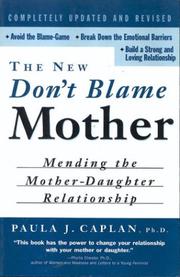
Cover of The New Don't Blame Mother

The New Don't Blame Mother

Paula Caplan

2000

In 1990, Paula Caplan, a nationally recognized expert on the psychology of women, wrote the groundbreaking Don'tBlame Mother. Now, almost ten years later, she finds that we are still blaming mothers. Fully revised, updated with a new introduction, this second edition proposes new ways of mending the mother-daughter relationship. The NewDon't Blame Mother: Mending the Mother-DaughterRelationship shows us that dangerous myths about mothers pervade our culture and have created or aggravated many of the problems between mothers and daughters. Myths of the Perfect Mother give rise to impossible expectations and set mothers up for failure--good mothers don't get angry, good mothers are endlessly giving--and myths of the Bad Mother exaggerate mothers' failings and create a monster figure in her image--mothers are too needy, mothers can't let go. Caplan shows that if women can identify these myths then they can take concrete steps to build a strong and loving relationship with their mothers. The New Don't Blame Mother shows how the anger and agony of the mother-daughter relationship can be replaced with a new bond based on understanding and respect. The New Don't Blame Mother is a must-read for all mothers and daughters. Caplan, drawing on over twenty-five years of research, clinical practice, and the experience of workshop participants, will show you how to stop blaming mother and, instead, start loving her.

Published 2000
Books like The New Don't Blame Mother

Frequently Asked Questions

Which is easier to read: Culture and weight consciousness or The New Don't Blame Mother?
Reading difficulty depends on your familiarity with the genre. Check each book's page count and subject matter above, and start with whichever aligns better with books you've enjoyed before.
Can I read Culture and weight consciousness and The New Don't Blame Mother in any order?
Yes — these are standalone works. You don't need to read one before the other unless they're part of the same series.
Which book is better for beginners?
If you're new to this genre, look at the shorter book with broader appeal and start there. You can always come back for the other.

Are you an author? Promote your book or submit a free listing.

Affiliate Disclosure: As an Amazon Associate, we may earn from qualifying purchases. Book links on this page may be affiliate links. This does not affect our recommendations or the price you pay.