
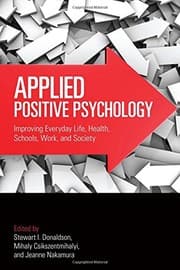
Applied positive psychology vs Sustainable happiness

Both "Applied positive psychology" by Stewart I. Donaldson, Jeanne Nakamura, Mihaly Csikszentmihalyi and "Sustainable happiness" by Joe Loizzo are popular choices for readers interested in Applied Psychology and Psychology, applied. This comparison helps you decide which to read first — or whether both belong on your list.

Shared Themes

Applied PsychologySELF-HELPPersonal GrowthSuccessHappiness
Cover of Applied positive psychology

Applied positive psychology

Stewart I. Donaldson, Jeanne Nakamura, Mihaly Csikszentmihalyi

2011

Positive psychological science has experienced extraordinary growth over the past two decades. Research in this area is revealing new strategies and interventions for improving everyday life, health and well-being, work, education, and societies across the globe. Contributions from luminaries in the field provide excellent reviews of the selected topics, summarizing empirical evidence, describing measurement tools, and offering recommendations for improving many aspects of our lives. Comprehensively updated, this second edition not only incorporates the more recent empirical findings; three new chapters on relationships and love, the importance of purpose, and the stimulation of education practice have been added. Focused on peer-reviewed and theory-driven psychological science, this book uniquely establishes a bridge between the intellectual movement for positive psychology and how it works in the real world. This collection of chapters will inspire the reader to creatively find new opportunities to better the human condition, whether these are in our lives, schools, health care settings, or workplaces. This book will be of interest to all psychologists and social scientists, applied researchers, program designers and evaluators, educators, leaders, students, and anyone interested in applying the science of positive psychology to improve everyday life and/or to promote social betterment and justice locally and globally.

Published 2011
Books like Applied positive psychology
Cover of Sustainable happiness

Sustainable happiness

Joe Loizzo

2012

Today’s greatest health challenges, the so-called diseases of civilization—depression, trauma, obesity, cancer—are now known in large part to reflect our inability to tame stress reflexes gone wild and to empower instead the peaceful, healing and sociable part of our nature that adapts us to civilized life. The same can be said of the economic challenges posed by the stress-reactive cycles of boom and bust, driven by addictive greed and compulsive panic. As current research opens up new horizons of stress-cessation, empathic intelligence, peak performance, and shared happiness, it has also encountered Asian methods of self-healing and interdependence more effective and teachable than any known in the West. Sustainable Happiness is the first book to make Asia’s most rigorous and complete system of contemplative living, hidden for centuries in Tibet, accessible to help us all on our shared journey towards sustainable well-being, altruism, inspiration and happiness.

Published 2012
Books like Sustainable happiness

Frequently Asked Questions

Which is easier to read: Applied positive psychology or Sustainable happiness?
Reading difficulty depends on your familiarity with the genre. Check each book's page count and subject matter above, and start with whichever aligns better with books you've enjoyed before.
Can I read Applied positive psychology and Sustainable happiness in any order?
Yes — these are standalone works. You don't need to read one before the other unless they're part of the same series.
Which book is better for beginners?
If you're new to this genre, look at the shorter book with broader appeal and start there. You can always come back for the other.

Are you an author? Promote your book or submit a free listing.

Affiliate Disclosure: As an Amazon Associate, we may earn from qualifying purchases. Book links on this page may be affiliate links. This does not affect our recommendations or the price you pay.