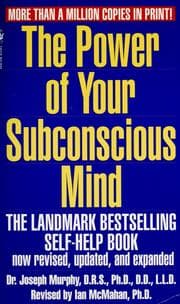

Cover of The Power of Your Subconscious Mind

The Power of Your Subconscious Mind

by Joseph Murphy

Published 1963

He visto cómo les ocurren milagros a hombres y mujeres de toda condición alrededor del planeta. Los milagros también le ocurrirán a usted cuando comience a utilizar el poder mágico de su mente subconsciente. Este libro se propone enseñarle que su manera habitual de pensar y los esquemas de su imaginación configuran y crean su destino; pues lo que el hombre piensa en su mente inconsciente que es, eso es. ¿Por qué un hombre está triste y otro alegre? ¿Por qué un hombre es jubiloso y próspero, y otro, pobre y mísero? ¿Por qué un hombre está temeroso y lleno de ansiedad y otro exuda fe y confianza? ¿Por qué un hombre tiene una hermosa y elegante mansión mientras que otro arrastra una mezquina existencia en un barrio miserable? ¿Por qué un hombre constituye todo un éxito mientras que otro es un desgraciado fracaso?¿Por qué un orador se distingue y es inmensamente popular, y otro mediocre e impopular? ¿Por qué un hombre es un genio en su trabajo mientras que otro se mata trabajando toda su vida sin hacer ni conseguir nada que valga realmente la pena? ¿Por qué sana un hombre de una de esas llamadas enfermedades incurables y otro no? ¿Por qué tanta gente religiosa, que es bondadosa y amable, sufre los tormentos de los condenados en cuerpo y alma? ¿Por qué tanta gente inmoral e impía tiene éxito, y prospera, y goza de radiante salud? ¿Por qué una mujer tiene un matrimonio feliz y su hermana es desgraciada y está llena de frustraciones?¿Existe una respuesta a estas interrogantes en las operaciones mente consciente y su mente subconsciente? Indudablemente que sí. Los objetivos específicos son: contestar y aclarar las preguntas anteriores y muchas otras de naturaleza semejante. Dr.Joseph Murphy

Self-HelpPsychologyNonfictionPersonal Development

Similar Books

Cover of You are not the target

You are not the target

Laura Archera Huxley

In this charming book, Laura Archera Huxley offers practical wisdom on how a human being in a chaotic world can cope with stress, anxiety, competition, & the uncertainty of the times. When we change,Ó she writes, others change too, & circumstances change in a manner that is almost miraculous,Ó & she points out that making others feel better generally makes us feel better.Ó Laura Huxley shows you how to change, how to influence the elements around you, how to cope successfully with the problems of the inner & outer world. To achieve this, she offers more than 33 Recipes for Living & Loving. A pioneering book of psychological good sense. Deceptively simple.Ó

Cover of The magic of believing

The magic of believing

Claude M. Bristol

Claude M. Bristol's "The Magic of Believing" explores the profound impact of a positive and unwavering belief system on achieving one's goals. The book argues that cultivating a strong conviction in the possibility of success, coupled with persistent action, is the fundamental driver behind personal and professional accomplishments. Bristol provides practical insights and real-world examples to illustrate how harnessing the power of belief can overcome obstacles and manifest desired outcomes.

Cover of Human motivation

Human motivation

Bernard Weiner

`Weiner's third textbook on motivation has more emphasis on emotion than its predecessors. There is also a new organization around basic metaphors... there is particularly good and up-to-date coverage of attributional approaches' - Cognition and Emotion Successful with over 24,000 students in two earlier motivation books, Weiner's text - newly available in paperback - depicts motivation as an unfolding story with plot and characters. He offers insights into the history and study of motivation and captures the excitement of the field as it evolves. Theories are explored in the context of the dominant metaphor, or paradigm, of various eras. First to be discussed is the machine metaphor, which to

Cover of Your perfect right

Your perfect right

Robert E. Alberti, Michael L. Emmons

Guidance and support for people who lack confidence, have trouble maintaining relationships, or need to learn to defend themselves is provided in this time-tested guide to building self-esteem, protecting oneself from bullying or abuse, and making constructive use of anger. Realistic exercises are designed to be practiced in daily life, applied to struggles both small and large, and notably strengthen self-confidence and assertiveness. Una ayuda enorme para gente que se siente insegura, tiene dificultad en mantener relaciones positivas o necesita aprender como defenderse, este libro demuestra como adquirir seguridad en sí mismo, proteger sus derechos, enfrentar y controlar el enojo y relacionarse con personas "difíciles." Los procedimientos descritos son realistas, prácticos y han probado su eficacia.

Cover of Seeing young children

Seeing young children

Warren R. Bentzen

Seeing Young Children is an extensive guide to observing and recording behavior in children from birth through age eight. It begins by addressing the basic meaning of observation and why it is so important. This includes a discussion of the theoretical and practical aspects of observing and recording behavior. Detailed information on development, behavior and functioning in children in this age group enables parents and professionals to make meaningful observation, recordings, and evaluations. A large portion of the book concentrates on in-depth reviews of recording techniques and instruments, as well as the advantages and disadvantages of each. Finally, the last five chapters offer a wealth of observation exercises readers can immediately put to use. Specific by age group, each of these chapters contains observation objectives, instructions as to procedure, and background information on many functional areas, all aimed at collecting and using quality data to the benefit of children.

Cover of Your child at play

Your child at play

Marilyn M. Segal

Packed with learning activities, games, poems, and recipes, as well as anecdotes and advice, the eight sections focus on: Individual Differences and Common Threads (distinguishing between real and pretend; concern with fairness; self-awareness) The Questions Children Ask (the physical world; the natural world; the social world) Friends (best friends; controversies and conflicts; sibling play) Active Play (contact and cuddling; physical feats; sports) Creative Play (music; art; crafts; storytelling and jokes) Pretend Play (actor play and dressing up; imaginary playmates; reemergence of pretending) School Play (reading; writing; arithmetic; collecting facts; science) Family (attachment and separation; family continuity; traditions)

Explore More

Affiliate Disclosure: As an Amazon Associate, we may earn from qualifying purchases. Book links on this page may be affiliate links. This does not affect our recommendations or the price you pay.