
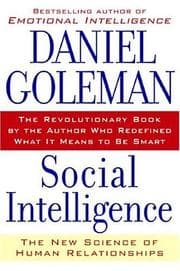
Cover of Social Intelligence

Social Intelligence

by Daniel Goleman

Published 2006

Redefines the nature of human relationships and its impact on every aspect of daily life, bringing together the latest research in biology and brain science to reveal how one's daily encounters shape the brain and affect the body.

Social aspects of IntellectPsychologySocial aspectsIntelligenceEmotionsSocial aspects of IntelligenceInterpersonal relationsNonfictionSocial aspects of EmotionsIntellectSocial intelligenceLarge type books

Similar Books

Cover of Creating love

Creating love

Bradshaw, John

“Why are so many of us at times completely baffled by a relationship? How can we think we know someone so well and admit in the end that we hardly knew that person at all? Why do many people who work diligently and strenuously to gain wholeness and balance still feel so frustrated about having a fulfilling relationship? Why have so many people given up on love?”—from the Prologue John Bradshaw’s bestselling books and compelling PBS series have touched and changed millions of lives. Now, in Creating Love, he offers us a new way to understand our most crucial relationships—with our romantic partners and spouses, with our parents and children, with friends and co-workers, with ourselves, and with God. Bradshaw’s compassionate approach shows that many of us have been literally “entranced” by past experiences of counterfeit love, so we unknowingly re-create patterns that can never fulfill us. Here he provides both the insights and the precise tools we need to keep those destructive patterns from repeating in the present. And then he shows how we can open ourselves to the soul-building work of real love—and create healthy, loving relationships where we can be fully ourselves in every part of our lives.

Cover of African American grief

African American grief

Paul C. Rosenblatt

African American Grief is a unique contribution to the field, both as a professional resource for counselors, therapists, social workers, clergy, and nurses, and as a reference volume for thanatologists, academics, and researchers. The classic edition includes a new preface from the authors reflecting on their work and on the changes in society and the field since the book’s initial publication. This work considers the potential effects of slavery, racism, and white ignorance and oppression on the African American experience and conception of death and grief in America. Based on interviews with 26 African Americans who have faced the death of a significant person in their lives, the authors document, describe, and analyze key phenomena of the unique African American experience of grief. The book combines moving narratives from the interviewees with sound research, analysis, and theoretical discussion of important issues in thanatology, as well as topics such as the influence of the African American church, gospel music, family grief, medical racism as a cause of death, and discrimination during life and after death.

Cover of Cognitive-behavioral therapy for smoking cessation

Cognitive-behavioral therapy for smoking cessation

Kenneth A. Perkins, Kenneth A. Perkins, Cynthia A. Conklin, Michele D. Levine

Cognitive-Behavioral Therapy (CBT) for Smoking Cessation is an essential resource for healthcare providers assisting patients in quitting tobacco smoking, presenting a structured approach that utilizes key components of CBT. This second edition provides empirically supported strategies for smoking cessation, adhering to well-established best practices and representing a "gold standard" in treatment. It presents step-by-step techniques to enhance patients’ motivation and confidence, prepare them to quit, navigate postquit challenges, and achieve long-term abstinence. This updated edition takes a patient-centered approach, addressing significant challenges faced during cessation and offering providers a systematic framework for delivering care. Notably, this volume introduces an adjunct CBT module specifically designed for patients very concerned about gaining weight after quitting—a unique and validated approach that aids cessation efforts and is not available in other resources. The book also includes new case vignettes, provider scripts, sidebars addressing common patient concerns, and key takeaways. Additionally, an extensive e-resource provides links to supplementary materials and further readings, equipping providers from diverse disciplines and backgrounds with the tools needed to effectively support patients. A must-have resource on the bookshelf of any health professional treating clients with tobacco dependence.

Cover of Working with substance misusers

Working with substance misusers

Trudi Petersen, Andrew McBride

Working with Substance Misusers is a practical handbook for students and those who work with people who misuse drugs or alcohol. Written by experienced teachers and clinicians, the book introduces: * the substances themselves * theories relevant to substance use and misuse * the skills necessary to work with this client group * the broad range of approaches to treatment * particular problems of specific groups. The reader is encouraged to read and reflect on the material in relation to their own practice. To help this process, each topic has an identified set of learning objectives. Activities designed to reinforce learning include discussion points, case studies, role plays and group exercises. Working with Substance Misusers makes clear the connection of theory to practice and encourages a skills-based, but reflective, approach to work in this complex field. Cutting across professional boundaries, it provides both new and more experienced practitioners with a key text.

Cover of Seeing young children

Seeing young children

Warren R. Bentzen

Seeing Young Children is an extensive guide to observing and recording behavior in children from birth through age eight. It begins by addressing the basic meaning of observation and why it is so important. This includes a discussion of the theoretical and practical aspects of observing and recording behavior. Detailed information on development, behavior and functioning in children in this age group enables parents and professionals to make meaningful observation, recordings, and evaluations. A large portion of the book concentrates on in-depth reviews of recording techniques and instruments, as well as the advantages and disadvantages of each. Finally, the last five chapters offer a wealth of observation exercises readers can immediately put to use. Specific by age group, each of these chapters contains observation objectives, instructions as to procedure, and background information on many functional areas, all aimed at collecting and using quality data to the benefit of children.

Cover of The Art of War

The Art of War

孙武 (Sun Tzu), Stephen F. Kaufman, Lionel Giles, Onésimo Colavidas

Sun Tzu's ancient treatise, "The Art of War," offers timeless strategic principles applicable beyond the battlefield to business, politics, and personal conflict. It emphasizes understanding oneself and the enemy, the importance of deception and adaptability, and the value of achieving victory with minimal confrontation. Through its concise aphorisms and insightful observations, the work provides a framework for decisive action and the cultivation of superior strategic thinking.

Explore More

Affiliate Disclosure: As an Amazon Associate, we may earn from qualifying purchases. Book links on this page may be affiliate links. This does not affect our recommendations or the price you pay.