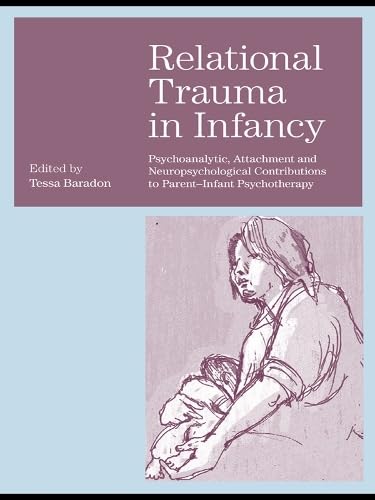
Cover of Relational trauma in infancy

Relational trauma in infancy

by Tessa Baradon

Published 2009

Attachment Trauma Recovery offers a simple and compassionate path for anyone struggling with emotional patterns rooted in childhood. Unlike general self help books, this guide explains clearly why your reactions feel overwhelming and teaches you how to calm your nervous system, reparent your inner child and build relationships that feel safe and secure. With practical tools, gentle exercises and easy to understand guidance, it helps you break long standing cycles and create lasting emotional stability. This book stands out because it combines clarity, warmth and actionable steps that make true healing possible even if you have struggled for years.

Mental healthFamily psychotherapyParent-Child RelationsPsychologyInfantParentingTherapyParent-infant psychotherapyInfantsStress Disorders, Post-TraumaticFamily TherapyParent and child

Similar Books

Cover of The practice of psychoanalytic parent infant psychotherapy

The practice of psychoanalytic parent infant psychotherapy

Tessa Baradon

The Practice of Psychoanalytic Parent-Infant Psychotherapy is a comprehensive handbook, addressing the provision of therapeutic help for babies and their parents when their attachment relationship is troubled and a risk is posed to the baby's development. Drawing on clinical and research data from neuroscience, attachment and psychoanalysis, the book presents a clinical treatment approach that is up-to-date, flexible and sophisticated, whilst also being clear and easy to understand. The first section: The theory of psychoanalytic parent infant psychotherapy – offers the reader a theoretical framework for understanding the emotional-interactional environment within which infant development takes place. The second section, The therapeutic process, invites the reader into the consulting room to participate in a detailed examination of the relational process in the clinical encounter. The third section, Clinical papers, provides case material to illustrate the unfolding of the therapeutic process. This new edition draws on evidence from contemporary research, with new material on: Embodied communication between parent and infant and clinician-patient/s Fathers and fathering Engagement of at-risk populations Written by a team of experienced clinicians, writers, teachers and researchers in the field of infant development and psychopathology, The Practice of Psychoanalytic Parent-Infant Psychotherapy will be an essential resource for all professionals working with children and their families, including child psychiatrists, psychoanalysts, psychotherapists, and clinical and developmental psychologists.

Cover of Counseling addicted families

Counseling addicted families

Gerald A. Juhnke

Although one person's addiction almost inevitably affects his or her family members, a surprising number of treatment models appear to operate under the assumption that an individual's addiction occurs in a vacuum. By not paying sufficient attention to preexisting family dynamics-whether dysfunctional, supportive, or somewhere in between-counselors run the risk of not fully understanding the roots of an individual's addictions or the obstacles to his recovery; as a result, counselors may undermine their own treatment efforts both by neglecting any underlying family problems and by failing to capitalize upon a family's potential assistance in an intervention with the addicted individual. In Counseling Addicted Families, Gerald A. Juhnke and William Bryce Hagedorn address this problem head-on. Recognizing that even those treatment providers who understand the importance of the familial context of addiction are often stymied by the variety of family treatment theories and their often imperfect fit for cases of addiction, Juhnke and Hagedorn provide a truly integrated model for assessment and treatment. Based upon the authors' combined 23 years of experience in clinical and treatment supervision, the Integrated Family Addictions Model consists of six progressive treatment tiers which organize the relevant family treatment theories into a graduated and coherent sequence, beginning with the briefest and least costly forms of therapy. If one of the lower tiers allows clients to reach their treatment goals, the patient and therapist need not waste time and resources following the full continuum. If, however, their needs are still unmet, they can progress in a logical fashion to more advanced and intensive forms of therapy. The book is divided into three broad topic areas designed to provide counselors and graduate students with essential information both about addictions and about the practical applications of various treatment theories. Part One discusses the prevalence of

Cover of Finding Your Way with Your Baby

Finding Your Way with Your Baby

Dilys Daws, Alexandra De Rementeria

Finding Your Way with Your Baby explores the emotional experience of the baby in the first year, and that of the mother, father and other significant adults. It does so in a way that is deeply informed by psychoanalytic understandings, infant observation, developmental science and decades of clinical experience. Combining the wisdom of many years' work with the freshness of up-to-date knowledge, Dilys Daws and Alexandra de Rementeria engage with the most difficult emotional experiences that are often glossed over in parenting books – such as pregnancy, through birth into bonding, ambivalence about the baby, depression, and the emotional turmoil so often brought to the surface by being a new parent. Acknowledgement and understanding about this darker side of family life offers a sense of relief that can allow parents to harness the power of knowing, owning and sharing feelings to transform situations and break negative cycles and old ways of relating. With real-life examples, references to current thinking and a calm and simple writing style they also provide new insights into the more commonly covered issues such as weaning, sleeping and crying. Finding Your Way with Your Baby is primarily aimed at parents but it will be a helpful resource for all those working with parents and babies including health visitors, midwives, social workers, GPs, paediatricians and childcare workers. It will appeal to parents and professionals who are interested in ideas from psychoanalytic clinical practice and the latest research in developmental psychology and neuroscience.

Cover of The parent survival guide

The parent survival guide

Theresa Kellam

When parents turn to the parenting/self-help section of their local bookstore, they are looking for both practical guidance and a childrearing philosophy that resonates with them - an approach they can relate to and be comfortable implementing in their own household. In The Parent Survival Guide: From Chaos to Harmony in Ten Weeks or Less, Theresa Kellam presents a way to strengthen the relationship with the child that simultaneously promotes the parent's own emotional healing and wellness. Grounded in a research-supported therapeutic technique that uses structured play time as the catalyst for interpersonal connection and growth, Kellam's model is subtle in its simplicity. Through a series of guided exercises, Kellam gives parents the skills they need to begin to set aside special playtimes with their children, during which the most important part of the process is simply "being there" in a way that promotes healing, growth, and communication. The beauty of this approach is that in only 30 minutes, once a week, the results can be seen in only a few weeks. Features of the book include: "Parent Survival Tip" at the start of each chapter Original cartoon illustrations bring text to life Short but insightful workseet questions bring focus to the program The Parent Survival Guide is structured over a series of 10 chapters, which can be read in conjunction with the 10-sessions of the CPRT workshops for those parents enrolled in a formal filial training program. But the material in the book is designed to be read and implemented by anyone. The author is not only a licensed psychologist and filial therapist, but she has also gone through the program with her own son and continues to rely on its principles within her family.

Cover of Father-Daughter Relationships

Father-Daughter Relationships

Linda Nielsen

In this fully revised new edition, Father-Daughter Relationships: Contemporary Research and Issues summarises and analyses the most relevant research regarding father-daughter relationships, aiming to break down the persistent misconceptions regarding fatherhood and father-daughter relationships and encourage the reader to take a more objective and analytical approach. The research is brought to life with compelling personal stories from fathers and daughters, including well-known celebrities and politicians. Boxed quizzes and questionnaires show students how the research can be applied to their own lives while others highlight the relationships between real-life fathers and daughters. Nielsen discusses the father-daughter relationship within a diverse range of family structures, including divorced and separated parents, gay parents, adopted children and children of sperm donors. Covering a wide range of topics, including the father’s impact on his daughter’s cognitive, academic, social and physical wellbeing, ethnic minorities, and incarcerated or abusive fathers, Father-Daughter Relationships: Contemporary Research and Issues gives panoramic view of the most recent research and statistics. This book is essential reading for upper level undergraduate and for graduate students, as well as for practitioners working with families, such as social workers, mental health professionals and family counsellors. It is especially relevant for courses in psychology, sociology, women’s studies, and counselling. Linda Nielsen is a Professor of Adolescent and Educational Psychology at Wake Forest University. A member of the faculty for 35 years, she is a nationally recognized expert on father-daughter relationships.
Cover of Creating love

Creating love

Bradshaw, John

“Why are so many of us at times completely baffled by a relationship? How can we think we know someone so well and admit in the end that we hardly knew that person at all? Why do many people who work diligently and strenuously to gain wholeness and balance still feel so frustrated about having a fulfilling relationship? Why have so many people given up on love?”—from the Prologue John Bradshaw’s bestselling books and compelling PBS series have touched and changed millions of lives. Now, in Creating Love, he offers us a new way to understand our most crucial relationships—with our romantic partners and spouses, with our parents and children, with friends and co-workers, with ourselves, and with God. Bradshaw’s compassionate approach shows that many of us have been literally “entranced” by past experiences of counterfeit love, so we unknowingly re-create patterns that can never fulfill us. Here he provides both the insights and the precise tools we need to keep those destructive patterns from repeating in the present. And then he shows how we can open ourselves to the soul-building work of real love—and create healthy, loving relationships where we can be fully ourselves in every part of our lives.

Cover of Ikigai: The Japanese Secret to a Long and Happy Life

Ikigai: The Japanese Secret to a Long and Happy Life

Héctor García (Author), Francesc Miralles (Author) Format: Hardcover

INTERNATIONAL BESTSELLER • 2 MILLION+ COPIES SOLD WORLDWIDE “Workers looking for more fulfilling positions should start by identifying their ikigai.” ―Business Insider “One of the unintended—yet positive—consequences of the [pandemic] is that it is forcing people to reevaluate their jobs, careers, and lives. Use this time wisely, find your personal ikigai, and live your best life.” ―Forbes Find your ikigai (pronounced ee-key-guy) to live longer and bring more meaning and joy to all your days. “Only staying active will make you want to live a hundred years.” —Japanese proverb According to the Japanese, everyone has an ikigai—a reason for living. And according to the residents of the Japanese village with the world’s longest-living people, finding it is the key to a happier and longer life. Having a strong sense of ikigai—where what you love, what you’re good at, what you can get paid for, and what the world needs all overlap—means that each day is infused with meaning. It’s the reason we get up in the morning. It’s also the reason many Japanese never really retire (in fact there’s no word in Japanese that means retire in the sense it does in English): They remain active and work at what they enjoy, because they’ve found a real purpose in life—the happiness of always being busy. In researching this book, the authors interviewed the residents of the Japanese village with the highest percentage of 100-year-olds—one of the world’s Blue Zones. Ikigai reveals the secrets to their longevity and happiness: how they eat, how they move, how they work, how they foster collaboration and community, and—their best-kept secret—how they find the ikigai that brings satisfaction to their lives. And it provides practical tools to help you discover your own ikigai. Because who doesn’t want to find happiness in every day? What’s your ikigai?

Cover of Becoming Supernatural: How Common People Are Doing The Uncommon

Becoming Supernatural: How Common People Are Doing The Uncommon

Dr. Joe Dispenza (Author), Adam Boyce (Narrator), Author's Republic (Publisher) & 0 more Format: Audible Audiobook

A WALL STREET JOURNAL BESTSELLER by DR. JOE DISPENZA , the author of the New York Times bestseller You Are the Placebo, as well as Breaking the Habit of Being Yourself and Evolve Your Brain. Becoming Supernatural draws on epigenetics, quantum physics & neuroscience research conducted at his advanced workshops since 2012 to explore how common people are doing the uncommon to transform their consciousness, mindset, and beliefs to heal and live SUPERNATURAL lives. Becoming Supernatural marries some of the most profound scientific information with ancient spiritual wisdom to show how people like you and me can experience a more mystical life. Readers will learn that we are, quite literally supernatural by nature if given the proper knowledge and instruction, and when we learn how to apply that information through various healing meditations, we should experience a greater expression of our creative abilities. We have the capacity to tune in to frequencies beyond our material world and receive more orderly coherent streams of consciousness and energy; that we can intentionally change our brain chemistry to initiate profoundly mystical transcendental experiences; and how, if we do this enough times, we can develop the skill of creating a more efficient, balanced, healthy body, a more unlimited mind, and greater access to the quantum field and the realms of spiritual truth. Topics include: • Demystifying the body’s 7 energy centers and how you can balance them to heal • How to free yourself from the past by reconditioning your body to a new mind • How you can create reality in the generous present moment by changing your energy • The difference between third-dimension creation and fifth-dimension creation • The secret science of the pineal gland and its role in accessing mystical realms of reality • The distinction between Space-Time vs. Time-Space realities • And much more Chapters Include: Opening the Door to the Supernatural The Present Moment Tuning In to New Potential

Explore More

Affiliate Disclosure: As an Amazon Associate, we may earn from qualifying purchases. Book links on this page may be affiliate links. This does not affect our recommendations or the price you pay.