

Cover of Parenting for a peaceful world

Parenting for a peaceful world

by Robin Grille

Published 2005

Imagine a world where war, tyranny, human rights abuses and ecological destruction are relics of the past. What if the means to create such a reality were in the hands of mothers and fathers, and all those involved in the care and education of children? Parenting for a Peaceful World is a fascinating look at how parenting customs have shaped societies and major world events. It reveals how children adapt to different parenting styles and how these early experiences underpin the adults they become. In this expansive book, Robin Grille draws on revolutionary new research to argue that the safeguarding of children's emotional development is the key to creating a more peaceful and harmonious world. Parenting for a Peaceful World is a book for parents, child health professionals, and adults learning to be whole again. It is a manifesto for policy-makers and a resource for teachers. If the findings outlined in these pages are put into practice, the result may be a revolution of peace, humanity, and a world beyond our imagining.

Social aspectsParent and childPsychological aspectsChild psychologyPsychological aspects of Child rearingPopular worksChild rearingSocial aspects of Child rearingHistoryParenting and child careParenting

Similar Books

Cover of The practice of psychoanalytic parent infant psychotherapy

The practice of psychoanalytic parent infant psychotherapy

Tessa Baradon

The Practice of Psychoanalytic Parent-Infant Psychotherapy is a comprehensive handbook, addressing the provision of therapeutic help for babies and their parents when their attachment relationship is troubled and a risk is posed to the baby's development. Drawing on clinical and research data from neuroscience, attachment and psychoanalysis, the book presents a clinical treatment approach that is up-to-date, flexible and sophisticated, whilst also being clear and easy to understand. The first section: The theory of psychoanalytic parent infant psychotherapy – offers the reader a theoretical framework for understanding the emotional-interactional environment within which infant development takes place. The second section, The therapeutic process, invites the reader into the consulting room to participate in a detailed examination of the relational process in the clinical encounter. The third section, Clinical papers, provides case material to illustrate the unfolding of the therapeutic process. This new edition draws on evidence from contemporary research, with new material on: Embodied communication between parent and infant and clinician-patient/s Fathers and fathering Engagement of at-risk populations Written by a team of experienced clinicians, writers, teachers and researchers in the field of infant development and psychopathology, The Practice of Psychoanalytic Parent-Infant Psychotherapy will be an essential resource for all professionals working with children and their families, including child psychiatrists, psychoanalysts, psychotherapists, and clinical and developmental psychologists.

Cover of The five love languages of children

The five love languages of children

Gary D. Chapman, Ross Campbell

Does your child speak a different language? Sometimes they wager for your attention, and other times they ignore you completely. Sometimes they are filled with gratitude and affection, and other times they seem totally indifferent. Attitude. Behavior. Development. Everything depends on the love relationship between you and your child. When children feel loved, they do their best. But how can you make sure your child feels loved? Since 1992, Dr. Gary Chapman's best-selling book The Five Love Languages has helped more than 300,000 couples develop stronger, more fulfilling relationships by teaching them to speak each others love language. Each child, too, expresses and receives love through one of five different communication styles. And your love language may be totally different from that of your child. While you are doing all you can to show your child love, he may be hearing it as something completely opposite.Discover your child's primary language and learn what you can do to effectively convey unconditional feelings of respect, affection, and commitment that will resonate in your child's emotions and behavior.

Cover of Building resilience in children and teens

Building resilience in children and teens

Kenneth R. Ginsburg, Martha M. Jablow

Confronting the overwhelming amount of stress kids face today, this invaluable guide offers coping strategies for facing the combined elements of academic performance, high achievement standards, media messages, peer pressure, and family tension. The handbook acknowledges that adolescents commonly survive stress by either indulging in unhealthy behaviors or giving up completely, and its suggested solutions are aimed at strengthening resilience. The proposed plan enables kids from the age of 18 months to 18 years to build the seven crucial "C's"--Competence, confidence, connection, character, co.

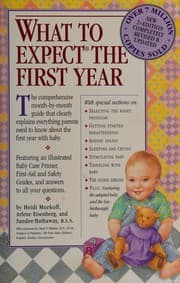
Cover of What to expect the first year

What to expect the first year

Heidi Murkoff, Arlene Eisenberg, Sandee E. Hathaway

Now fully revised and updated, this comprehensive and practical month-by-month guide clearly explains everything parents need to know - or might be worrying about - in the first year with a new baby. Featuring special sections on older siblings, travelling with a baby, adopted babies, and specific problems, as well as a first aid guide and charts on monthly growth and development, feeding and sleeping habits, this is the only book on infant care to address both the physical and the emotional needs of the whole family. Covering the most up-to-date knowledge, both medical and developmental, WHAT TO EXPECT THE 1st YEAR is, above all, down-to-earth and reassuring - and an invaluable aid for all parents of new babies.

Cover of Finding Your Way with Your Baby

Finding Your Way with Your Baby

Dilys Daws, Alexandra De Rementeria

Finding Your Way with Your Baby explores the emotional experience of the baby in the first year, and that of the mother, father and other significant adults. It does so in a way that is deeply informed by psychoanalytic understandings, infant observation, developmental science and decades of clinical experience. Combining the wisdom of many years' work with the freshness of up-to-date knowledge, Dilys Daws and Alexandra de Rementeria engage with the most difficult emotional experiences that are often glossed over in parenting books – such as pregnancy, through birth into bonding, ambivalence about the baby, depression, and the emotional turmoil so often brought to the surface by being a new parent. Acknowledgement and understanding about this darker side of family life offers a sense of relief that can allow parents to harness the power of knowing, owning and sharing feelings to transform situations and break negative cycles and old ways of relating. With real-life examples, references to current thinking and a calm and simple writing style they also provide new insights into the more commonly covered issues such as weaning, sleeping and crying. Finding Your Way with Your Baby is primarily aimed at parents but it will be a helpful resource for all those working with parents and babies including health visitors, midwives, social workers, GPs, paediatricians and childcare workers. It will appeal to parents and professionals who are interested in ideas from psychoanalytic clinical practice and the latest research in developmental psychology and neuroscience.

Cover of Radical records

Radical records

Bob Cant, Susan Hemmings

The period between the publication in 1957 of the liberalising Wolfenden Report and the introduction in 1987 of the homophobic Section 28 was characterised by unprecedented optimism and political activism among lesbians and gay men in Britain. But the law and its shortcomings never determined their whole political and cultural agenda and Radical Records explores the diverse and sometimes conflicting attempts of lesbian and gay people to build a new world for themselves and those they loved. The contributors recount their own personal narratives of how they struggled to re-define their identities, to explore non-traditional expressions of intimacy, to reclaim public spaces, to engage with the HIV epidemic, to build alliances and, generally, to make radical transformations of their lives. The re-issue of this important work, first published in 1988, gives its readers an opportunity to re-visit that turbulent time through the voices of its participants.

Cover of Dangerous sexualities

Dangerous sexualities

Frank Mort

Dangerous Sexualities takes a look at how our ideas of health and disease are linked to moral and immoral notions of sex. Beginning in the 1830s, Frank Mort relates his social historical narratives to the sexual choices and possibilities facing us now. This long-awaited second edition has been thoroughly updated to include new discussions of eugenics, race hygiene and social imperialism in the late nineteenth and early twentieth centuries. With a new and extended bibliography, introduction and illustrations, this second edition brings a classic into the 21st Century.

Cover of Ikigai: The Japanese Secret to a Long and Happy Life

Ikigai: The Japanese Secret to a Long and Happy Life

Héctor García (Author), Francesc Miralles (Author) Format: Hardcover

INTERNATIONAL BESTSELLER • 2 MILLION+ COPIES SOLD WORLDWIDE “Workers looking for more fulfilling positions should start by identifying their ikigai.” ―Business Insider “One of the unintended—yet positive—consequences of the [pandemic] is that it is forcing people to reevaluate their jobs, careers, and lives. Use this time wisely, find your personal ikigai, and live your best life.” ―Forbes Find your ikigai (pronounced ee-key-guy) to live longer and bring more meaning and joy to all your days. “Only staying active will make you want to live a hundred years.” —Japanese proverb According to the Japanese, everyone has an ikigai—a reason for living. And according to the residents of the Japanese village with the world’s longest-living people, finding it is the key to a happier and longer life. Having a strong sense of ikigai—where what you love, what you’re good at, what you can get paid for, and what the world needs all overlap—means that each day is infused with meaning. It’s the reason we get up in the morning. It’s also the reason many Japanese never really retire (in fact there’s no word in Japanese that means retire in the sense it does in English): They remain active and work at what they enjoy, because they’ve found a real purpose in life—the happiness of always being busy. In researching this book, the authors interviewed the residents of the Japanese village with the highest percentage of 100-year-olds—one of the world’s Blue Zones. Ikigai reveals the secrets to their longevity and happiness: how they eat, how they move, how they work, how they foster collaboration and community, and—their best-kept secret—how they find the ikigai that brings satisfaction to their lives. And it provides practical tools to help you discover your own ikigai. Because who doesn’t want to find happiness in every day? What’s your ikigai?

Cover of Becoming Supernatural: How Common People Are Doing The Uncommon

Becoming Supernatural: How Common People Are Doing The Uncommon

Dr. Joe Dispenza (Author), Adam Boyce (Narrator), Author's Republic (Publisher) & 0 more Format: Audible Audiobook

A WALL STREET JOURNAL BESTSELLER by DR. JOE DISPENZA , the author of the New York Times bestseller You Are the Placebo, as well as Breaking the Habit of Being Yourself and Evolve Your Brain. Becoming Supernatural draws on epigenetics, quantum physics & neuroscience research conducted at his advanced workshops since 2012 to explore how common people are doing the uncommon to transform their consciousness, mindset, and beliefs to heal and live SUPERNATURAL lives. Becoming Supernatural marries some of the most profound scientific information with ancient spiritual wisdom to show how people like you and me can experience a more mystical life. Readers will learn that we are, quite literally supernatural by nature if given the proper knowledge and instruction, and when we learn how to apply that information through various healing meditations, we should experience a greater expression of our creative abilities. We have the capacity to tune in to frequencies beyond our material world and receive more orderly coherent streams of consciousness and energy; that we can intentionally change our brain chemistry to initiate profoundly mystical transcendental experiences; and how, if we do this enough times, we can develop the skill of creating a more efficient, balanced, healthy body, a more unlimited mind, and greater access to the quantum field and the realms of spiritual truth. Topics include: • Demystifying the body’s 7 energy centers and how you can balance them to heal • How to free yourself from the past by reconditioning your body to a new mind • How you can create reality in the generous present moment by changing your energy • The difference between third-dimension creation and fifth-dimension creation • The secret science of the pineal gland and its role in accessing mystical realms of reality • The distinction between Space-Time vs. Time-Space realities • And much more Chapters Include: Opening the Door to the Supernatural The Present Moment Tuning In to New Potential

Explore More

Affiliate Disclosure: As an Amazon Associate, we may earn from qualifying purchases. Book links on this page may be affiliate links. This does not affect our recommendations or the price you pay.