
Community Treatment of Drug Misuse
Nicholas Seivewright
Combines highly practical approach with strong research base to provide comprehensive guide to treatment and service provision.

Published 2007
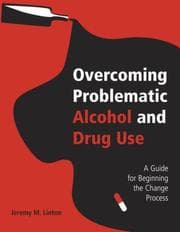
Overcoming Problematic Alcohol and Drug Use is a workbook for use with clients in treatment, informed by the most current research and literature in the substance abuse field. Offering a field-tested alternative to the disease model of addiction, the book introduces a six-session curriculum for treating persons with substance abuse issues and can be used as a self-help resource, or as a practice guide for human service professionals. Drawing on years of research on cognitive-behavioral therapy, the stages of change model, motivational interviewing, and solution-focused therapy, the author has put together a comprehensive and effective guide to change.

Nicholas Seivewright
Combines highly practical approach with strong research base to provide comprehensive guide to treatment and service provision.

Gerald A. Juhnke
Although one person's addiction almost inevitably affects his or her family members, a surprising number of treatment models appear to operate under the assumption that an individual's addiction occurs in a vacuum. By not paying sufficient attention to preexisting family dynamics-whether dysfunctional, supportive, or somewhere in between-counselors run the risk of not fully understanding the roots of an individual's addictions or the obstacles to his recovery; as a result, counselors may undermine their own treatment efforts both by neglecting any underlying family problems and by failing to capitalize upon a family's potential assistance in an intervention with the addicted individual. In Counseling Addicted Families, Gerald A. Juhnke and William Bryce Hagedorn address this problem head-on. Recognizing that even those treatment providers who understand the importance of the familial context of addiction are often stymied by the variety of family treatment theories and their often imperfect fit for cases of addiction, Juhnke and Hagedorn provide a truly integrated model for assessment and treatment. Based upon the authors' combined 23 years of experience in clinical and treatment supervision, the Integrated Family Addictions Model consists of six progressive treatment tiers which organize the relevant family treatment theories into a graduated and coherent sequence, beginning with the briefest and least costly forms of therapy. If one of the lower tiers allows clients to reach their treatment goals, the patient and therapist need not waste time and resources following the full continuum. If, however, their needs are still unmet, they can progress in a logical fashion to more advanced and intensive forms of therapy. The book is divided into three broad topic areas designed to provide counselors and graduate students with essential information both about addictions and about the practical applications of various treatment theories. Part One discusses the prevalence of

Trudi Petersen, Andrew McBride
Working with Substance Misusers is a practical handbook for students and those who work with people who misuse drugs or alcohol. Written by experienced teachers and clinicians, the book introduces: * the substances themselves * theories relevant to substance use and misuse * the skills necessary to work with this client group * the broad range of approaches to treatment * particular problems of specific groups. The reader is encouraged to read and reflect on the material in relation to their own practice. To help this process, each topic has an identified set of learning objectives. Activities designed to reinforce learning include discussion points, case studies, role plays and group exercises. Working with Substance Misusers makes clear the connection of theory to practice and encourages a skills-based, but reflective, approach to work in this complex field. Cutting across professional boundaries, it provides both new and more experienced practitioners with a key text.

Adrian Barton
The second edition of the popular Illicit Drugs: Use and Control provides a timely, up-to-date discussion of the key issues raised in the first edition, whilst also providing new chapters which address: Class, gender and race, The geo-politics of illicit drug production and distribution, Britain's drug use within a global context. This accessible book, with its inclusion of new pedagogical features, will be essential reading for students and researchers working in the area of drugs and society.

Daniel F. Seidman
I'M TOO STRESSED TO STOP. I'LL GAIN WEIGHT IF I QUIT. I'VE TRIED AND FAILED TOO MANY TIMES TO COUNT. Why are you still smoking, even though you want to quit? Based on twenty years of research and hands-on work with countless smokers in his clinics at Columbia University and New York Presbyterian Hospital, Dr. Daniel F. Seidman understands that people smoke -- and quit -- for different reasons and what works for one smoker might not work for another. • Are you a Situational Smoker? Monitoring your reactions in different situations is a step toward permanently losing interest in cigarettes. • Are you a Worried-about-Weight Smoker? Properly using treatments like Nicotine Replacement Therapy (NRT) can help you quit and get healthy in all aspects of your life. • Are you an Emotion-Triggered Smoker? Scheduling your smoking breaks and sticking to a rigid "smoking schedule" helps break the link between stressful situations and craving cigarettes. In a comprehensive, 30-day program, Dr. Seidman explains how to retrain your brain, take advantage of all the tools at your disposal, and end the month smoke-free and feeling stronger than ever!

Gina Bellisario, Renée Kurilla
"Keep Calm!" by Gina Bellisario and Renée Kurilla offers young readers practical strategies for navigating feelings of anxiety and stress. Through relatable scenarios and engaging illustrations, the book guides children in understanding their emotions and developing coping mechanisms. It provides accessible tools and simple techniques to help them manage worry and find moments of calm.

Ric Bucher
Ric Bucher's memoir chronicles his descent into addiction and depression following a career-ending injury, detailing his struggle to rebuild his life from its lowest point. Through raw honesty, he explores the profound impact of his personal demons on his relationships and self-worth. The narrative ultimately charts his arduous path toward recovery and finding a renewed sense of purpose and joy.

Sebastian Mallaby
This book chronicles the improbable journey of Marine Colonel Gregory Boyington's team as they spearheaded Project Maven, a groundbreaking initiative to integrate artificial intelligence into drone warfare. Mallaby details the complex challenges of overcoming bureaucratic inertia and technical hurdles to equip military drones with AI for target identification. The narrative highlights the ethical and strategic implications of this nascent era of AI-driven conflict, showcasing the human ingenuity behind a significant technological leap.

Donella H. Meadows
This insightful memoir chronicles a year-long experiment where the author, Donella H. Meadows, attempted to delegate a significant portion of her daily tasks and responsibilities to artificial intelligence. Meadows meticulously documents her experiences, exploring the practical applications, surprising limitations, and evolving relationship between human agency and AI-driven assistance across various facets of her life. The narrative offers a compelling examination of the potential and pitfalls of integrating AI into everyday routines, prompting reflection on work, creativity, and the very definition of human productivity.
Affiliate Disclosure: As an Amazon Associate, we may earn from qualifying purchases. Book links on this page may be affiliate links. This does not affect our recommendations or the price you pay.