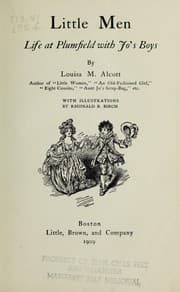

Cover of Little men

Little men

by Louisa May Alcott

Published 1885

This sparkling sequel to the beloved Little Women follows the grown-up and married Jo, mistress of Plumfield, a school for boys (and a few girls, too). The fun begins with a new arrival, Nat Blake; it is through his eyes that we first meet Plumfield's lively residents and experience the cheerful confusion that reigns in the welcoming home

Louisa May AlcottChildrenChildren'sKid'sJuvenileHistoryHistoricalFictionClassicLiteratureStoriesBook

Similar Books

Cover of Jo's Boys

Jo's Boys

Louisa May Alcott

How is this book unique? Font adjustments & biography included Unabridged (100% Original content) Illustrated About Jo's Boys by Louisa May Alcott Jo's Boys, and How They Turned Out: A Sequel to "Little Men" is a novel by American author Louisa May Alcott, first published in 1886. The novel is the final book in the unofficial Little Women series. In it, Jo's "children," now grown, are caught up in real world troubles.The book mostly follows the lives of Plumfield boys who were introduced in Little Men, particularly Tommy, Emil, Demi, Nat, Dan, and Professor Bhaer and Jo's sons Rob and Teddy, although the others make frequent appearances as well. The book takes place ten years after Little Men. Dolly and George are college students dealing with the temptations of snobbery, arrogance, self-indulgence and vanity. Tommy becomes a medical student to impress childhood sweetheart Nan, but after "accidentally" falling in love with and proposing to Dora, he joins his family business.

Cover of Eight cousins

Eight cousins

Louisa May Alcott

How is this book unique? Font adjustments & biography included Unabridged (100% Original content) Illustrated About Eight Cousins by Louisa May Alcott "Eight Cousins, or The Aunt-Hill" was published in 1875 by American novelist Louisa May Alcott. It is the story of Rose Campbell, a lonely and sickly girl who has been recently orphaned and must now reside with her maiden great aunts, the matriarchs of her wealthy Boston family. When Rose's guardian, Uncle Alec, returns from abroad, he takes over her care. Through his unorthodox theories about child-rearing, she becomes happier and healthier while finding her place in her family of seven boy cousins and numerous aunts and uncles. She also makes friends with Phebe, her aunts' young housemaid, whose cheerful attitude in the face of poverty helps Rose to understand and value her own good fortune. Each chapter describes an adventure in Rose's life as she learns to help herself and others make good choices. Rose must define for herself her role as the only woman of her generation in her family and as an heiress in Boston's elite society.

Cover of The Railway Children

The Railway Children

Edith Nesbit

Rediscover the Puffin Classics collection and bring the best-loved classics to a new generation - including this charming edition of The Railway Children. When Father is taken away unexpectedly, Roberta, Peter, Phyllis and their mother have to leave their comfortable life in London to go and live in a small cottage in the country. The children seek solace in the nearby railway station, and make friends with Perks the Porter and the Station Master himself. Each day, Roberta, Peter and Phyllis run down the field to the railway track and wave at the passing London train, sending their love to Father. Little do they know that the kindly old gentleman passenger who waves back holds the key to their father's disappearance. One of the best-loved classics of all time, with a wonderful introduction by Jacqueline Wilson.

Cover of Great Expectations

Great Expectations

Charles Dickens

Great Expectations was first published as a weekly serial in All the Year Round, December 1860 - August 1861. Its first appearance in volume form was as three-volume novel, without illustrations, in July 1861. A one-volume edition, the next year, preceded its inclusion in the collected editions of Dickens's lifetime. The three-volume 1861 edition is the basis of the present text: variant readings, including those in manuscript and extant proofs, are recorded in the textual apparatus, providing an unusually rich source of information on Dickens's methods of composition. The Introduction traces this process of composition and draws attention to the two unperformed dramatic adaptations: the reading version and the 1861 play version, made as a safeguard of copyright. Appendices include the original ending, the author's notes, and two textual examinations, one of the five so-called `editions' of 1861, the other a comparison of the one-volume 1862 edition with the 1864 Library edition.

Cover of The Freedom of Life

The Freedom of Life

Annie Payson Call

Annie Payson Call's "The Freedom of Life" offers a practical philosophy for achieving inner peace and mental well-being by emphasizing the power of conscious thought and disciplined will. The book guides readers toward self-mastery, asserting that true freedom lies not in external circumstances but in cultivating a serene and resilient inner life through consistent self-effort and a positive outlook. Call's enduring insights provide a framework for navigating life's challenges with greater equanimity and purpose, fostering personal growth and sustained happiness.

Cover of The climacteric in perspective

The climacteric in perspective

International Congress on the Menopause (4th 1984 Lake Buena Vista, Fla.), M. Notelovitz, P.A. van Keep

The Fourth International Congress on the Menopause was held in Lake Buena Vista, Florida, USA in October - November 1984. It was different from the previous meetings held under the auspices of the International Menopause Society in three respects: the duration of the Congress was extended to five days, plenary sessions were held on each day, and the scope of the subject matter was expanded to provide a total or holistic overview of the subject - hence the theme for the Congress 'Climacteric Medicine and Science: A Societal need. ' In recent years there has been an increased interest in the menopause and middle year aging by scientists and clinicians in fields as diverse as anthropology, urodynamics, nutrition and exercise physiology, while 'newer' issues in clinical medicine, such as osteoporosis prevention and management, attracted specialists in nuclear immaging techniques and internal medicine. Over 120 invited speakers plus numerous contributors to the free communication, special lectures and the poster sessions provided a virtual cornucopia of information on the menopause, that has indeed brought a newer perspective to a subject previously the domain of a single specialty, the gynecologist, and dominated by a single therapy, estrogen replacement.

Cover of Blink

Blink

Malcolm Gladwell

Drawing on cutting-edge neuroscience and psychology and displaying all of the brilliance that made The Tipping Point a classic, Blink changes the way you'll understand every decision you make. Never again will you think about thinking the same way. Malcolm Gladwell redefined how we understand the world around us. Now, in Blink, he revolutionizes the way we understand the world within. Blink is a book about how we think without thinking, about choices that seem to be made in an instant - in the blink of an eye - that actually aren't as simple as they seem. Why are some people brilliant decision makers, while others are consistently inept? Why do some people follow their instincts and win, while others end up stumbling into error? How do our brains really work - in the office, in the classroom, in the kitchen, and in the bedroom? And why are the best decisions often those that are impossible to explain to others? In Blink we meet the psychologist who has learned to predict whether a marriage will last, based on a few minutes of observing a couple; the tennis coach who knows when a player will double-fault before the racket even makes contact with the ball; the antiquities experts who recognize a fake at a glance. Here, too, are great failures of "blink": the election of Warren Harding; "New Coke"; and the shooting of Amadou Diallo by police. Blink reveals that great decision makers aren't those who process the most information or spend the most time deliberating, but those who have perfected the art of "thin-slicing" - filtering the very few factors that matter from an overwhelming number of variables. Drawing on cutting-edge neuroscience and psychology and displaying all of the brilliance that made The Tipping Point a classic, Blink changes the way you understand every decision you make. Never again will you think about thinking the same way.

Explore More

Affiliate Disclosure: As an Amazon Associate, we may earn from qualifying purchases. Book links on this page may be affiliate links. This does not affect our recommendations or the price you pay.