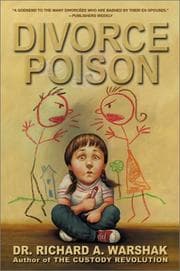
Cover of Divorce Poison

Divorce Poison

by Richard A. Warshak

Published 2003

View on Amazon

Check availability on Amazon

Are you the author or publisher of this book?

Claim this book — Free

Update metadata for “Divorce Poison” after verification.

BestsellerFinder Score unavailable — not enough catalog data yet.

The author offers readers the antidote to post-divorce venom, pointing the way to a mature, measured response to an ex's attempt to poison the atmosphere between child and parent. 30,000 first printing.

Divorced parentsParentingChildren of divorced parentsParent and childCareParent-Child RelationsParents divorcésRôle parentalEnfants de divorcésSoinsParents et enfants

Similar Books

Cover of Family Wisdom from the Monk Who Sold His Ferrari

Family Wisdom from the Monk Who Sold His Ferrari

Robin S. Sharman

Richard Carlson, author of the worldwide bestseller Don't Sweat the Small Stuff says that Family Wisdom is "a wonderful book that will help you become a better parent as well as a happier person." This is Robin's most profound book yet, rich with truly life-changing ideas on balancing work and family, transforming your family culture and creating a life that fills your heart with joy, fulfillment and peace. This book will show you exactly how to unlock your child's highest abilities, deepen your relationships and leave a lasting legacy.
Cover of The practice of psychoanalytic parent infant psychotherapy

The practice of psychoanalytic parent infant psychotherapy

Timothy N. Liesching

The Practice of Psychoanalytic Parent-Infant Psychotherapy is a comprehensive handbook, addressing the provision of therapeutic help for babies and their parents when their attachment relationship is troubled and a risk is posed to the baby's development. Drawing on clinical and research data from neuroscience, attachment and psychoanalysis, the book presents a clinical treatment approach that is up-to-date, flexible and sophisticated, whilst also being clear and easy to understand. The first section: The theory of psychoanalytic parent infant psychotherapy – offers the reader a theoretical framework for understanding the emotional-interactional environment within which infant development takes place. The second section, The therapeutic process, invites the reader into the consulting room to participate in a detailed examination of the relational process in the clinical encounter. The third section, Clinical papers, provides case material to illustrate the unfolding of the therapeutic process. This new edition draws on evidence from contemporary research, with new material on: Embodied communication between parent and infant and clinician-patient/s Fathers and fathering Engagement of at-risk populations Written by a team of experienced clinicians, writers, teachers and researchers in the field of infant development and psychopathology, The Practice of Psychoanalytic Parent-Infant Psychotherapy will be an essential resource for all professionals working with children and their families, including child psychiatrists, psychoanalysts, psychotherapists, and clinical and developmental psychologists.

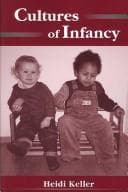
Cover of Cultures of Infancy

Cultures of Infancy

Heidi Keller

The Classic Edition of Heidi Keller's Cultures of Infancy, first published in 2007, includes a new introduction by the author, describing for readers the original context for her work, how she has further developed her research and thinking, and the ongoing relevance of this volume in the context of future challenges for the field. In its original volume, Cultures of Infancy presented the first systematic analysis of culturally informed developmental pathways, synthesizing evolutionary and cultural psychological perspectives for a broader understanding of human development. In this compelling book, Heidi Keller utilizes ethnographic reports, as well as quantitative and qualitative analyses, to illustrate how humans resolve universal developmental tasks in particular sociodemographic contexts. These contexts are represented in cultural models, and three distinct models are addressed throughout the text: the model of independence with autonomy as developmental organizer; the model of interdependence with relatedness as the developmental organizer; and the model of autonomous relatedness representing particular mixtures of autonomy and relatedness. The book offers an empirical examination of the first integrative developmental task-relationship formation during the early months of life. Keller shows that early parenting experiences shape the basic foundation of the self within particular models of parenting that are influenced by culturally informed socialization goals. With distinct patterns of results the studies have revealed, Cultures of Infancy helps redefine developmental psychology as part of a culturally informed science based on evolutionary groundwork. Scholars interested in a broad perspective on human development and culture will benefit from this pioneering volume.

Cover of The parent survival guide

The parent survival guide

Theresa Kellam

When parents turn to the parenting/self-help section of their local bookstore, they are looking for both practical guidance and a childrearing philosophy that resonates with them - an approach they can relate to and be comfortable implementing in their own household. In The Parent Survival Guide: From Chaos to Harmony in Ten Weeks or Less, Theresa Kellam presents a way to strengthen the relationship with the child that simultaneously promotes the parent's own emotional healing and wellness. Grounded in a research-supported therapeutic technique that uses structured play time as the catalyst for interpersonal connection and growth, Kellam's model is subtle in its simplicity. Through a series of guided exercises, Kellam gives parents the skills they need to begin to set aside special playtimes with their children, during which the most important part of the process is simply "being there" in a way that promotes healing, growth, and communication. The beauty of this approach is that in only 30 minutes, once a week, the results can be seen in only a few weeks. Features of the book include: "Parent Survival Tip" at the start of each chapter Original cartoon illustrations bring text to life Short but insightful workseet questions bring focus to the program The Parent Survival Guide is structured over a series of 10 chapters, which can be read in conjunction with the 10-sessions of the CPRT workshops for those parents enrolled in a formal filial training program. But the material in the book is designed to be read and implemented by anyone. The author is not only a licensed psychologist and filial therapist, but she has also gone through the program with her own son and continues to rely on its principles within her family.

Cover of Father-Daughter Relationships

Father-Daughter Relationships

Linda Nielsen

In this fully revised new edition, Father-Daughter Relationships: Contemporary Research and Issues summarises and analyses the most relevant research regarding father-daughter relationships, aiming to break down the persistent misconceptions regarding fatherhood and father-daughter relationships and encourage the reader to take a more objective and analytical approach. The research is brought to life with compelling personal stories from fathers and daughters, including well-known celebrities and politicians. Boxed quizzes and questionnaires show students how the research can be applied to their own lives while others highlight the relationships between real-life fathers and daughters. Nielsen discusses the father-daughter relationship within a diverse range of family structures, including divorced and separated parents, gay parents, adopted children and children of sperm donors. Covering a wide range of topics, including the father’s impact on his daughter’s cognitive, academic, social and physical wellbeing, ethnic minorities, and incarcerated or abusive fathers, Father-Daughter Relationships: Contemporary Research and Issues gives panoramic view of the most recent research and statistics. This book is essential reading for upper level undergraduate and for graduate students, as well as for practitioners working with families, such as social workers, mental health professionals and family counsellors. It is especially relevant for courses in psychology, sociology, women’s studies, and counselling. Linda Nielsen is a Professor of Adolescent and Educational Psychology at Wake Forest University. A member of the faculty for 35 years, she is a nationally recognized expert on father-daughter relationships.

Cover of Finding Your Way with Your Baby

Finding Your Way with Your Baby

Stan Skrabut

Finding Your Way with Your Baby explores the emotional experience of the baby in the first year, and that of the mother, father and other significant adults. It does so in a way that is deeply informed by psychoanalytic understandings, infant observation, developmental science and decades of clinical experience. Combining the wisdom of many years' work with the freshness of up-to-date knowledge, Dilys Daws and Alexandra de Rementeria engage with the most difficult emotional experiences that are often glossed over in parenting books – such as pregnancy, through birth into bonding, ambivalence about the baby, depression, and the emotional turmoil so often brought to the surface by being a new parent. Acknowledgement and understanding about this darker side of family life offers a sense of relief that can allow parents to harness the power of knowing, owning and sharing feelings to transform situations and break negative cycles and old ways of relating. With real-life examples, references to current thinking and a calm and simple writing style they also provide new insights into the more commonly covered issues such as weaning, sleeping and crying. Finding Your Way with Your Baby is primarily aimed at parents but it will be a helpful resource for all those working with parents and babies including health visitors, midwives, social workers, GPs, paediatricians and childcare workers. It will appeal to parents and professionals who are interested in ideas from psychoanalytic clinical practice and the latest research in developmental psychology and neuroscience.

Cover of What to expect the first year

What to expect the first year

Eisenberg

Now fully revised and updated, this comprehensive and practical month-by-month guide clearly explains everything parents need to know - or might be worrying about - in the first year with a new baby. Featuring special sections on older siblings, travelling with a baby, adopted babies, and specific problems, as well as a first aid guide and charts on monthly growth and development, feeding and sleeping habits, this is the only book on infant care to address both the physical and the emotional needs of the whole family. Covering the most up-to-date knowledge, both medical and developmental, WHAT TO EXPECT THE 1st YEAR is, above all, down-to-earth and reassuring - and an invaluable aid for all parents of new babies.

Cover of A good enough parent

A good enough parent

Bruno Bettelheim, Bruno Bettleheim

In this book, the preeminent child psychologist of our time gives us the results of his lifelong effort to determine what is most crucial in successful child-rearing. His purpose is not to give parents preset rules for raising their children, but rather to show them how to develop their own insights so that they will understand their own and their children's behavior in different situations and how to cope with it. Above all, he warns, parents must not indulge their impulse to try to create the child they would like to have, but should instead help each child fully develop into the person he or she would like to be.

Explore More

Affiliate Disclosure: As an Amazon Associate, we may earn from qualifying purchases. Book links on this page may be affiliate links. This does not affect our recommendations or the price you pay.