
Overcoming objectification vs The Taming of the Shrew

Both "The Taming of the Shrew" by William Shakespeare and "Overcoming objectification" by Ann J. Cahill are popular choices for readers interested in Drama and Married people. This comparison helps you decide which to read first — or whether both belong on your list.

Shared Themes

Sex role
Cover of Overcoming objectification

Overcoming objectification

Ann J. Cahill

2011

The second edition of Overcoming Objectification: A Carnal Ethics provides a critical analysis of the widely used (particularly in feminist philosophy) concept of objectification, and offers a new concept (derivatization) in its stead. Cahill suggests an abandonment of objectification due to the concept’s dependence on a Kantian ideal of personhood, an ideal that fails to recognize sufficiently the role the body plays in personhood and results in an implicit vilification of the body and sexuality. Phenomena associated with objectification are ethically problematic not because they render women objects, and therefore not-persons, but rather because they construct feminine subjectivity and sexuality as wholly derivative of masculine subjectivity and sexuality. Women are not objectified as much as they are derivatized: turned into a mere reflection or projection of the other. Cahill argues for a sexual ethics grounded in difference, carnality, and intersubjectivity. The preface to the second edition traces new scholarly contributions to conversations regarding sexual ethics, feminist engagements with Kant, intersectionality, and trans philosophy. With original and far-reaching insights regarding the structure of gender inequality, this work will be of interest to students and scholars in the humanities and social sciences alike and will be of particular use to those interested in sexual ethics, sexual assault, and dominant media representations of gendered bodies.
Published 2011
Books like Overcoming objectification
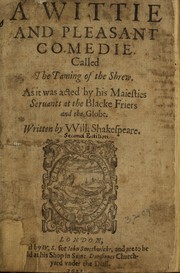
Cover of The Taming of the Shrew

The Taming of the Shrew

William Shakespeare

1631

The Wonder of Shakespeare One who reads a few of Shakespeare's great plays and then the meager story of his life is generally filled with a vague wonder. Here is an unknown country boy, poor and poorly educated according to the standards of his age, who arrives at the great city of London and goes to work at odd jobs in a theater. In a year or two he is associated with scholars and dramatists, the masters of their age, writing plays of kings and clowns, of gentlemen and heroes and noble women, all of whose lives he seems to know by intimate association. In a few years more he leads all that brilliant group of poets and dramatists who have given undying glory to the Age of Elizabeth. Play after play runs from his pen, mighty dramas of human life and character following one another so rapidly that good work seems impossible; yet they stand the test of time, and their poetry is still unrivaled in any language. For all this great work the author apparently cares little, since he makes no attempt to collect or preserve his writings. A thousand scholars have ever since been busy collecting, identifying, classifying the works which this magnificent workman tossed aside so carelessly when he abandoned the drama and retired to his native village. He has a marvelously imaginative and creative mind; but he invents few, if any, new plots or stories. He simply takes an old play or an old poem, makes it over quickly, and lo! this old familiar material glows with the deepest thoughts and the tenderest feelings that ennoble our humanity; and each new generation of men finds it more wonderful than the last. How did he do it? That is still an unanswered question and the source of our wonder.

Published 1631
Books like The Taming of the Shrew

Frequently Asked Questions

Which is easier to read: The Taming of the Shrew or Overcoming objectification?
Reading difficulty depends on your familiarity with the genre. Check each book's page count and subject matter above, and start with whichever aligns better with books you've enjoyed before.
Can I read The Taming of the Shrew and Overcoming objectification in any order?
Yes — these are standalone works. You don't need to read one before the other unless they're part of the same series.
Which book is better for beginners?
If you're new to this genre, look at the shorter book with broader appeal and start there. You can always come back for the other.

Are you an author? Promote your book or submit a free listing.

Affiliate Disclosure: As an Amazon Associate, we may earn from qualifying purchases. Book links on this page may be affiliate links. This does not affect our recommendations or the price you pay.