
Eating disorders vs Enduring change in eating disorders

Both "Eating disorders" by Laura J. Goodman and "Enduring change in eating disorders" by H. Charles Fishman are popular choices for readers interested in Eating disorders and Patients. This comparison helps you decide which to read first — or whether both belong on your list.

Shared Themes

Eating disordersTreatmentFeeding and Eating DisordersTherapyPsychology
Cover of Eating disorders

Eating disorders

Laura J. Goodman

2001

The widely updated second edition of Eating Disorders: Journey to Recovery Workbook helps those struggling with eating disorders in their recovery, guiding the reader through a greater consideration of body image, compulsive exercising, and personal and societal relationships based on Prochaska’s Stages of Change Theory. The workbook explores complicated issues having a direct effect on the eating disorder, including trauma, depression, gender identity, abuse, and the media. Updated to include the acknowledgement of binge-eating disorder, selective eating, and avoidant restrictive food intake disorder (ARFID), this second edition encourages self-paced learning and practice adjunct to one-on-one and group therapy from two seasoned clinicians in the treatment of eating disorders.
Published 2001
Books like Eating disorders
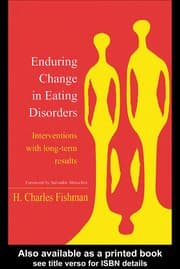
Cover of Enduring change in eating disorders

Enduring change in eating disorders

H. Charles Fishman

2004

Enduring Change in Eating Disorders provides a unique perspective on the successful treatment of eating disorders, which are among the most debilitating and recalcitrant psychiatric diseases. Unique in the field, this book details effective Structural Family Therapy with qualitative follow-ups of up to 20 years. A practical approach providing concrete tools to the clinician to creating change that holds over time with bulimia, anorexia, and compulsive overeating. The text draws on cases from the author's practice of over twenty-five years and follows his approach in the theoretical tradition of Intensive Structural Family Therapy (IST). Chapters discuss the nature and significance of eating disorders, a review of current treatment approaches, and the importance of the family in the therapeutic process. Cases of eating disorders in youths and adults are provided as well as instances of bulimia, anorexia, and compulsive overeating. Three appendices provide the reader with information regarding the scientific basis of the IST model, the effectiveness of the approach in treating conditions other than eating disorders and preventing eating disorders.

Published 2004
Books like Enduring change in eating disorders

Frequently Asked Questions

Which is easier to read: Eating disorders or Enduring change in eating disorders?
Reading difficulty depends on your familiarity with the genre. Check each book's page count and subject matter above, and start with whichever aligns better with books you've enjoyed before.
Can I read Eating disorders and Enduring change in eating disorders in any order?
Yes — these are standalone works. You don't need to read one before the other unless they're part of the same series.
Which book is better for beginners?
If you're new to this genre, look at the shorter book with broader appeal and start there. You can always come back for the other.

Are you an author? Promote your book or submit a free listing.

Affiliate Disclosure: As an Amazon Associate, we may earn from qualifying purchases. Book links on this page may be affiliate links. This does not affect our recommendations or the price you pay.